Quick answer
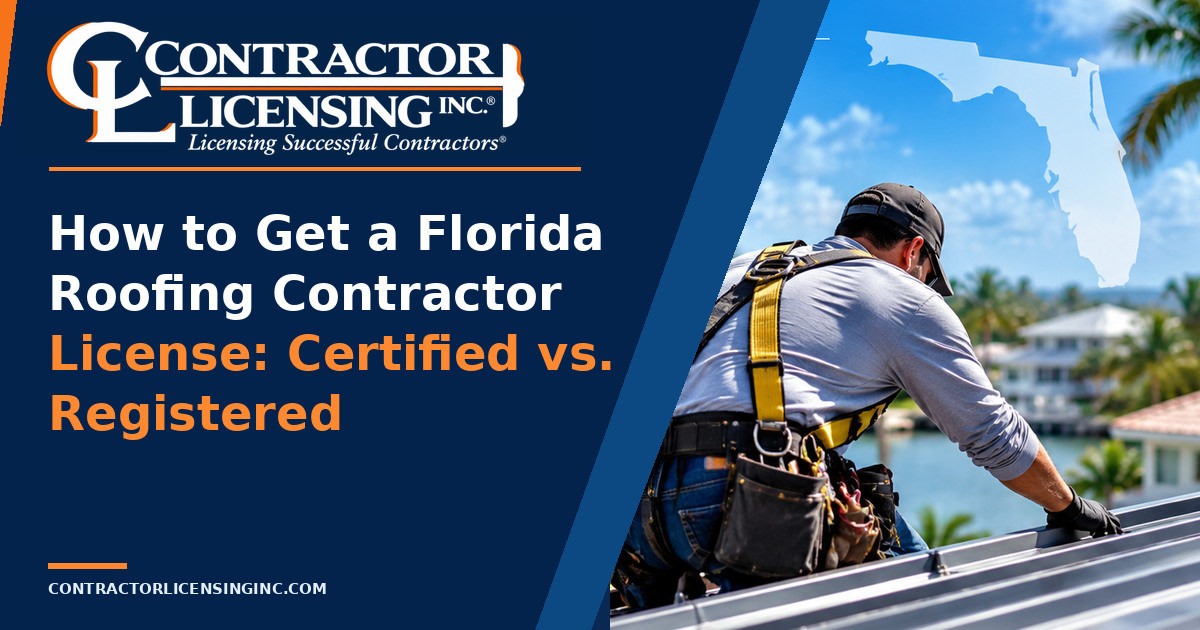
A Florida roofing contractor license comes in two forms. A certified license is issued by the state and lets you work anywhere in Florida. A registered license is based on a local license and limits you to that city or county. For the certified license, you need four years of experience (one as a foreman), passing scores on two exams, a credit report and insurance.
Who this is for: you’ve been working on roofs for a few years and want your own Florida roofing contractor license, or you hold a local roofing license and want to know if certified is worth it.
Florida treats roofing as its own licensed trade. You can’t legally contract for a roof without a Florida roofing contractor license, or a license that covers it. Here’s how the two versions differ and what it takes to get the certified one.
What does a Florida roofing contractor license cover?
A roofing contractor’s services are “unlimited in the roofing trade,” according to section 489.105(3)(e), Florida Statutes. That includes roofing, waterproofing and roof coatings, skylights, and required roof-deck attachments. It also covers replacing wood roof sheathing or fascia as needed during a roof repair or replacement. It also includes evaluating and strengthening roof-to-wall connections on structures with wood roof decking, as described in the Florida Building Code.
The law doesn’t spell out whether roof-mounted solar falls inside a roofer’s scope. Solar has its own license category. If you plan to do solar, ask us before you bid it.
Certified vs. registered roofing license: what’s the difference?
The difference is where you can work.
| Certified roofing contractor | Registered roofing contractor | |
|---|---|---|
| Issued by | The state (CILB, the board that approves your license) | The state, based on your local license |
| Where you can work | Anywhere in Florida | Only the cities or counties where you met local licensing requirements |
| How you qualify | State exams, experience, credit and insurance | A local competency license, then state registration |
| Renews | August 31 of even-numbered years | August 31 of odd-numbered years |
Under section 489.117, a registered contractor can contract “only in the counties, municipalities, or development districts” where they meet local requirements. If you work in more than one county, or plan to, certified is usually the better fit. Whether your county or city still gives its own roofing competency exam is something to check with that local licensing office.
How do you get a certified roofing license in Florida?
- Check your experience. DBPR’s roofing form lists four years of experience as a worker or foreman, with at least one year as a foreman. The law allows a few other routes too (section 489.111). DBPR counts one year as 2,000 hours. College credit can replace part of it.
- Apply for the exam and pass both parts. The roofing exam has two parts: Business and Finance, and Roofing Trade Knowledge.
- Gather your documents. That means a credit report with a FICO score, Livescan fingerprints, work history and insurance. See our application process guide.
- File the license application. Use form CILB 5-I if it’s just you. Use the 6-series roofing form if you’re qualifying a company.
What roofing experience counts?
The CILB 5-I form asks for experience in at least three of these roof types: shingles, metal, tile, concrete and solar tile. It also asks for experience in all of these: single-ply systems, underlayment, insulation, roof penetrations, parapet walls, flashings, and sheathing and framing repairs. If your work history is all shingle reroofs, plan how you’ll show the rest before you apply.
What credit and insurance do you need?
You need a FICO score of 660 or higher with no unsatisfied judgments or liens. If you’re under 660, you can complete a board-approved 14-hour financial responsibility course. For insurance, roofing falls under “all other categories” on the form: $100,000 public liability and $25,000 property damage. You also need workers’ comp coverage or an exemption.
Can a general contractor do roofing in Florida?
Usually not without subcontracting it. Section 489.113(3) says a contractor must subcontract roofing work unless they hold a state certificate or registration in roofing. There’s a narrow exception. General, building and residential contractors don’t have to subcontract the installation, or warranty repair, of wood shingles, wood shakes, or asphalt or fiberglass shingles on a new building of their own construction. DBPR’s FAQ adds that roofing work can’t be subcontracted to unlicensed roofers.
Can you upgrade a registered roofing license to certified?
Yes, if you meet section 489.118. You need a valid registered license and a local written exam the board finds substantially similar to the state exam. You also need at least five years of experience as a roofing contractor (or as an inspector or building administrator), plus the state’s insurance and financial requirements. Your record matters too: no revocation ever, and no suspension or fine over $500 in the last five years. We covered this in more detail in our post on getting to the next level roofing license.
Cost and timing
| Item | Amount | Source (as of October 14, 2026) |
|---|---|---|
| Exam registration (Professional Testing, Inc.) | $135 | DBPR exam application pack, rev. May 12, 2026 |
| Business and Finance exam (Pearson VUE) | $80 | Same |
| Roofing Trade Knowledge exam (Pearson VUE) | $80 | Same |
| License application fee | $245 (May 1 of even year to Aug 31 of odd year) or $145 (Sept 1 of odd year to Apr 30 of even year) VERIFY: CILB 5-I is dated July 2024. A separate March 2026 grandfathering form (CILB 29) lists $305 and $205. Confirm the fee on the current CILB 5-I before publishing. | CILB 5-I, eff. July 2024 |
Once you’re licensed, you need 14 hours of continuing education every two years. DBPR says roofing contractors must include one hour of Wind Mitigation Methodology in those 14 hours.
From our files
The roofing files that stall with us usually have the same gap. The applicant has years on roofs, but most of it was one roof type. The CILB 5-I wants experience in several roof types and systems, so we sit down and map each past job to the list before anything is filed. That conversation is easier before the application than after a deficiency letter.
Mistakes we see
- Assuming a local roofing license lets you work in the next county over.
- Listing experience that’s all one roof type when the form asks for several.
- Counting years instead of hours. DBPR counts a year as 2,000 hours.
- Bidding roof-mounted solar without checking whether your license covers it.
- Letting a general contractor’s license stand in for a roofing license on reroof jobs.
Frequently asked questions
How long does it take to get a Florida roofing contractor license?
It depends on how fast you pass both exams and how complete your application is. The experience requirement is the biggest factor: you need four years, including one as a foreman, before you can qualify the standard way.
Can I work anywhere in Florida with a registered roofing license?
No. A registered roofing contractor can only work in the cities or counties where they met local licensing requirements. A certified roofing license lets you work anywhere in the state.
What exams do I need for a Florida roofing license?
Two: the Business and Finance exam and the Roofing Trade Knowledge exam. Pearson VUE gives both, and DBPR’s exam pack lists $80 for each plus a $135 registration fee.
Does a Florida general contractor need a roofing license to do roofs?
In most cases, yes, or they have to subcontract the roofing to a licensed roofer. The exception is installing or warranty-repairing wood, asphalt or fiberglass shingles or wood shakes on a new building of the contractor’s own construction.
How much insurance does a Florida roofing contractor need?
The CILB form lists $100,000 in public liability and $25,000 in property damage for roofing. You also need workers’ comp coverage or an exemption.
Ready to file your roofing license?
We’ve filed Florida contractor applications since 2007. Send us your roofing experience and we’ll build the application around it.
Questions? Call 239-394-2300. More on the license: Florida roofing contractor license.
Sources
- Section 489.105, Florida Statutes, checked October 14, 2026
- Section 489.111, Florida Statutes, checked October 14, 2026
- Section 489.113, Florida Statutes, checked October 14, 2026
- Section 489.115, Florida Statutes, checked October 14, 2026
- Section 489.117, Florida Statutes, checked October 14, 2026
- Section 489.118, Florida Statutes, checked October 14, 2026
- DBPR form CILB 5-I, Certified Roofing Contractor (Individual), eff. July 2024, checked October 14, 2026
- DBPR exam application pack, rev. May 12, 2026, checked October 14, 2026
- DBPR Construction Industry FAQs, checked October 14, 2026
This article is general information, not legal advice.