How Long Does a Florida Contractor License Application Take? DBPR Timeframes Explained
You’ve passed the exams. Your insurance is in place. Your experience is documented. You submit your Florida contractor license application — and then you wait.
For most contractors, the question becomes: how long is this actually going to take? The honest answer is that it depends on two things: how clean your application is, and whether your paperwork requires board-level review. Understanding how the DBPR and CILB process applications — including the monthly board meeting calendar that can add weeks or months to your timeline — is the single most useful thing you can know before you submit.
This guide breaks down realistic timeframes at every stage, explains why the board meeting calendar matters more than most contractors realize, and covers exactly what you can do to keep your application moving forward.
The Two Paths: Administrative Approval vs. Board Review
Before diving into timelines, it’s important to understand that not all Florida contractor license applications follow the same path to approval. There are two distinct tracks:
Administrative Approval — A DBPR examiner reviews your complete application, confirms all requirements are met, and approves it without sending it to the full CILB board. This is the faster path. Clean, complete applications with no credit issues, no criminal history flags, no experience gray areas, and no financial concerns can be approved administratively within 4 to 6 weeks of submission.
Board Review — Your application is flagged for presentation to the full Construction Industry Licensing Board at one of its scheduled monthly meetings. This is required when the application involves credit issues, prior disciplinary history, criminal background matters, disputed experience, or any factor that falls outside clear administrative criteria. Once an application goes to board review, the CILB meeting calendar — not the DBPR examiner queue — controls your timeline.
The critical thing to understand: the difference between these two paths is often determined by how well your application is prepared, not just by whether you have issues. A borderline credit situation that’s clearly explained with supporting documentation may sail through administratively. The same situation presented without context may get flagged for the board — adding 30 to 60 days or more to your wait.
Standard Processing Timeline: The 4–6 Week Track
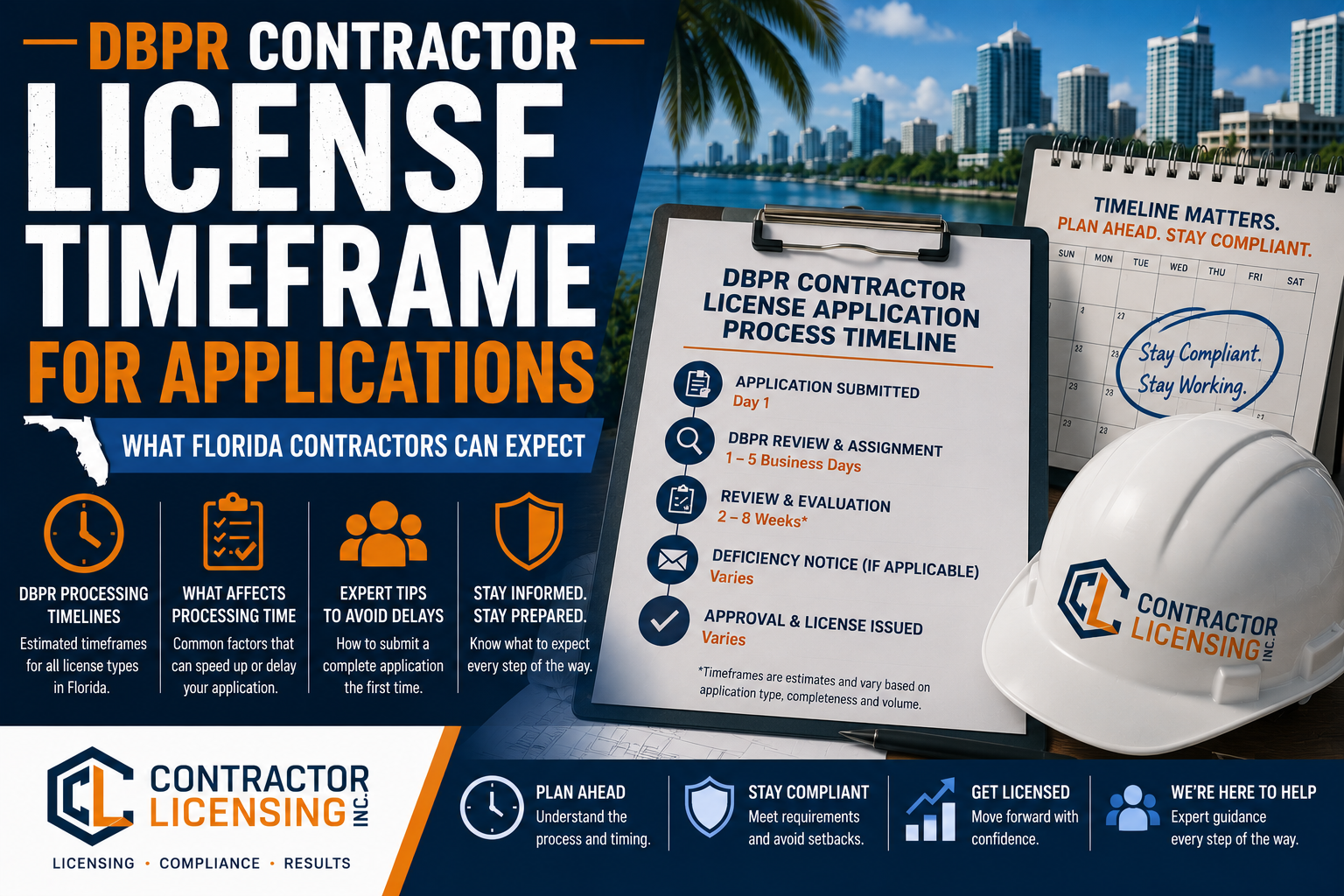
For a complete, deficiency-free application submitted to DBPR, here is what the timeline looks like:
Days 1–3: Application logs into the DBPR system. Administrative staff verify that the application fee has been received and that basic submission requirements are met.
Days 4–10: Application routes to an examiner queue. Staff verify completeness — all required forms, supporting documentation, insurance certificates, and fingerprint submission confirmation.
Days 11–30: Examiner reviews the substance of the application: experience verification, financial responsibility documentation, background check clearance, and exam score confirmation.
Days 30–45: If everything checks out and no board review is required, the license is approved. The license is issued and accessible through the DBPR portal. A physical license certificate arrives by mail within one to two weeks.
Total timeline for a clean, complete application: approximately 4 to 6 weeks from submission.
This is the best-case scenario — and it’s achievable with the right preparation. It’s also not the most common outcome for first-time applicants who put the application together themselves. The DBPR’s own guidance notes that applications are governed by Florida Statute §120.60, which technically gives the department up to 90 days to process an application. The 4–6 week window is realistic when everything is in order, but it is not guaranteed.
The Board Review Track: When the CILB Calendar Controls Your Timeline
Here is where contractors get blindsided. If your application requires review by the full Construction Industry Licensing Board, you are no longer on a 4–6 week track. You are on a board meeting calendar track — and the timing of when your application reaches the examiner relative to the next meeting’s cutoff date can determine whether you wait 6 weeks or 14.
The CILB consists of 18 members appointed by the Governor and confirmed by the Florida Senate. The board meets monthly to review license applications, disciplinary cases, and administrative matters. Each meeting has a submission cutoff — a deadline by which applications must be fully reviewed and prepared for the board’s agenda.
Here is the practical reality:
If your application clears the examiner’s review and is board-ready before the cutoff for the upcoming meeting, it goes on that month’s agenda. Add approximately 2–4 weeks from submission to examiner review, plus the time to the next meeting, and you’re looking at a total of 6–10 weeks.
If your application clears the examiner’s review just after the cutoff for the upcoming meeting, it rolls to the following month’s agenda. That single timing difference — a few days one way or the other — adds 30 days to your wait, without any change to the quality of your application.
If a deficiency is discovered after the examiner review and you respond after the cutoff for the next meeting, you wait for the month after that. Each deficiency cycle that overlaps a board meeting cutoff adds another full month to your timeline.
The result: contractors with applications that require board review commonly experience timelines of 8 to 14 weeks for straightforward board matters, and 3 to 6 months or longer when deficiency cycles are involved.
What Triggers Board Review?
Not every application goes to the board. Administrative approval is available for clean applications. The following factors are most likely to flag an application for board-level consideration:
Credit and Financial Issues A credit report below the DBPR’s threshold, unresolved judgments, active tax liens, or a bankruptcy within recent years will typically route your application to the board for a financial responsibility determination. The CILB reviews these situations individually — which is why documented explanation and supporting context matter significantly.
Criminal Background History Any disclosed criminal history — even resolved matters — triggers board review for a character assessment. The nature of the offense, the time elapsed, and evidence of rehabilitation all factor into the board’s determination.
Experience Documentation Gray Areas Applications where the qualifying experience falls in a gray area — self-employment periods, work performed under a disputed supervisor relationship, or experience in adjacent but not identical construction categories — are more likely to be elevated for board review.
Non-Standard Application Structures Applications involving non-owner qualifying agents, complex business entity structures, or multiple-company qualifications may require board approval.
Prior DBPR or CILB History Any prior licensing complaints, disciplinary matters, or application denials in Florida or other states will route the application to the board.
Deficiency Letters and the “Back of the Line” Effect
A deficiency letter is not the end of your application — but it is a timeline reset, and the way DBPR processing works makes each deficiency more expensive in time than most contractors expect.
When you receive a deficiency letter and respond, your application does not return to the top of the queue. It re-enters the examiner review process from the back, typically requiring another 30 to 45 days for an examiner to pick it back up. If the corrected application then misses the cutoff for that month’s CILB meeting, add another full cycle.
Two deficiency cycles on a board-track application can easily push your total timeline past 6 months.
Important distinction on the DBPR portal: When you check your application status online, sections marked as “Deficient” in the portal do not necessarily mean you have received an actual deficiency finding. During processing, DBPR marks incomplete review sections as deficient by default as examiners work through the file. A real deficiency finding arrives as a formal email from application.deficiencies@myfloridalicense.com — with your name, application number, and profession code in the subject line. Do not respond to a portal status flag as though it were a deficiency letter unless you have received that actual email.
The Board Approval Rate Reality
Recent CILB meeting minutes illustrate why application preparation quality matters so much. At the March 2026 CILB meeting, the board reviewed 168 applications for new licenses and additional business entities across Division I and Division II classifications. Of those 168 applications, only 61 were approved outright — a 36% outright approval rate. The remainder were continued (waiting for additional information or the next meeting), denied, or withdrawn.
“Continued” means the application is coming back at a future meeting — adding 30, 60, or 90 days depending on what’s needed and when the next meeting falls. “Denied” means the application did not meet the board’s standards and must be addressed before reapplication. “Withdrawn” typically means the applicant pulled the application before a denial could be recorded.
The difference between an outright approval and a continuation is frequently a matter of documentation completeness and presentation — not the substance of the applicant’s qualifications.
How to Check Your Application Status
The DBPR provides an online application status check through the portal at myfloridalicense.com. You can also call the DBPR Customer Contact Center at 850-487-1395 with your application number or Social Security number to get a status update.
If your application has been pending longer than 45 days with no communication and no deficiency letter, you can request an escalation — sometimes referred to as a “Tier-N” — by calling the DBPR directly. This is a formal escalation indicating that your application has not received timely attention. It won’t bypass the process, but it can prompt a review of where your application stands in the queue.
What You Can Do to Shorten Your Timeline
The most effective way to get a faster outcome is to eliminate the reasons for delay before you submit.
Submit a complete, consistent application the first time. Every name, entity, and address on your application, your insurance certificates, your DBPR account, and your Florida Division of Corporations registration must match exactly. Name variations — even minor ones — are a common deficiency trigger.
Have your experience documentation reviewed before submission. The DBPR CILB 4359 experience verification forms must be completed and signed by your supervising contractors — not by you. Project descriptions must be specific and detailed. Employment history must account for the full qualifying period with no unexplained gaps over 30 days.
Address financial and credit issues proactively. If your credit report shows negative items, don’t let the board encounter them cold. Prepare a written explanation and supporting documentation — evidence of resolution, payment plans in place, or extenuating circumstances — and include it with your application.
Understand the board meeting calendar. CILB meets monthly. If your application is going to require board review, the timing of your submission relative to the next meeting’s cutoff matters. Working with an experienced licensing service that tracks the board calendar can help you time your submission to minimize wait cycles.
Respond to deficiency letters immediately and completely. Do not partially respond and assume the remaining issues will be addressed later. A partial response generates a second deficiency cycle. Address every single item in the deficiency letter in a single, complete response.
Legal and Compliance Considerations
Do not begin contracting work before your license is issued. A pending application does not authorize licensed contracting activity in Florida. Performing regulated work before your license appears as active in the DBPR system exposes you to unlicensed activity violations under Florida Statute §489.127 — which can include fines, criminal charges, and jeopardizing your pending application.
Monitor your application status. Do not submit and assume. Check your portal status regularly and monitor the email address associated with your DBPR account. Deficiency letters are time-sensitive — most require a response within 30 to 60 days before the application risks administrative closure.
Inactive licenses from other states can create complications. If you hold a license in another state that is currently inactive, suspended, or subject to disciplinary action, disclose it. The CILB will discover it during the background review. Undisclosed prior licensing issues are treated far more seriously than disclosed ones.
Frequently Asked Questions
How long does it take to get a Florida contractor license? For a clean, complete application with no credit issues, no criminal history flags, and no experience gray areas, expect approximately 4 to 6 weeks from submission to license issuance. Applications that require board review add 4 to 8 weeks or more depending on where they fall in the CILB meeting calendar.
What is the CILB and when does it meet? The Construction Industry Licensing Board is the 18-member board that governs contractor licensing in Florida under the DBPR. The CILB meets monthly. Applications that require board-level approval — rather than administrative approval — must be on the agenda for a scheduled meeting. Missing a meeting cutoff by even a few days adds a full month to the timeline.
Why does my DBPR portal show deficient status if I haven’t received a deficiency letter? The DBPR portal marks uncompleted review sections as deficient by default during processing. This does not mean you have a formal deficiency. A real deficiency finding arrives as a formal email from application.deficiencies@myfloridalicense.com. Do not take action based on portal status alone without a formal deficiency email.
Can I speed up the DBPR review process? You cannot pay to expedite DBPR processing. The best way to shorten your timeline is to submit a complete, deficiency-free application and respond to any issues immediately and thoroughly. If your application has been pending more than 45 days without communication, you can call DBPR at 850-487-1395 and request a Tier-N escalation.
What happens if my application is continued at a board meeting? A “continued” outcome means the board needs additional information or documentation before making a decision. You will receive notice of what is needed and the application will be scheduled for a future meeting — typically the following month. Address the board’s concerns completely before the next submission cutoff.
Get It Right the First Time
The difference between a 4-week approval and a 4-month ordeal almost always comes down to preparation. A complete, board-ready application submitted at the right point in the CILB meeting cycle can be approved in under 6 weeks. The same application with missing documentation, unexplained credit issues, and timing that misses two consecutive board cutoffs can drag into late summer before a license is issued.
Contractor Licensing Inc. helps Florida contractors navigate the full DBPR application process — from organizing experience documentation to timing submissions around the CILB meeting calendar, responding to deficiency letters, and managing applications that require board review. We know what examiners look for, what the board looks for, and how to present your application in a way that moves.
Visit contractorlicensinginc.com or call our Florida office during business hours. Start the process with a plan — not a guess.
This article is for informational purposes only and does not constitute legal advice. DBPR processing times and CILB meeting schedules are subject to change. Always verify current processing status directly with the Florida DBPR at myfloridalicense.com or by calling 850-487-1395.