Why You Should Choose a Contractor Licensing Company That Doesn’t Offer Exam Prep
It sounds counterintuitive. Wouldn’t it be easier to use one company for everything — exam prep and license application processing all under one roof?
Maybe. But easier isn’t the same as better. And when it comes to getting your Florida contractor license approved, the company handling your application needs one thing above everything else: deep, undivided expertise in the DBPR process. When that same company is also running exam prep courses, selling books, and enrolling new students every week, your application is competing with a business model that wasn’t built around it.
Here’s why the cleanest separation you can make is between who prepares you for the exam and who processes your license application.
Two Completely Different Skills
Passing a contractor licensing exam and navigating a DBPR license application are not variations of the same task. They require entirely different knowledge, different relationships, and different expertise.
Exam prep is about teaching you the content of a standardized test. It’s educational. It involves study materials, practice questions, reference books, and familiarity with what the exam covers. A good exam prep company knows the CILB exam inside and out. That’s genuinely valuable — for passing the exam.
License application processing is about administrative law, CILB rule interpretation, documentation standards, deficiency resolution, board meeting calendars, and established relationships with DBPR staff. It requires knowing exactly how the examiner is going to read your experience verification forms, how the board will evaluate a credit issue, how to frame a response to a deficiency letter, and when to submit relative to the next CILB meeting to avoid an extra 30-day wait cycle.
These are not the same skill set. A company that does one of them exceptionally well does not automatically do both well.
The Conflict of Interest No One Talks About
Here’s the uncomfortable question: what happens to an exam prep company’s revenue when their students pass quickly and move on?
A contractor who passes their exams on the first attempt and gets their license issued cleanly is a great outcome for the contractor. For a company that monetizes exam prep courses, retakes, and extended study enrollments — it’s also the shortest possible billing relationship.
This isn’t an accusation. It’s a structural reality worth understanding. When a company’s business model includes both exam prep and application processing, there is at least a theoretical misalignment between what’s best for you and what generates the most revenue. More retakes mean more course renewals. More time in the exam prep pipeline is more time they have your attention and your wallet.
A company that handles only the licensing side of the process has no financial stake in how long it takes you to pass your exams. Their entire incentive is to get your application through the DBPR as fast and cleanly as possible — because that’s what they’re paid to do, and their reputation depends on it.
What Specialization Actually Looks Like in Practice
The DBPR processes approximately 200,000 active contractor licenses in Florida. The Construction Industry Licensing Board reviews hundreds of applications at every monthly meeting. The difference between a first-time approval and a “continued” outcome that adds 30 to 60 days to your timeline frequently comes down to how well your application is assembled — not the strength of your underlying qualifications.
A company that processes contractor license applications exclusively — not as an add-on to an exam prep business — develops something that generalists can’t replicate: pattern recognition built from volume and focus.
They have seen the specific ways DBPR examiners flag experience verification forms. They know which credit explanations the board responds to favorably and which ones create more questions. They understand how to document a self-employment period so it doesn’t come back as a deficiency. They track the CILB meeting calendar and know that submitting on the right side of a cutoff date can save you a month of waiting.
That institutional knowledge doesn’t come from teaching people how to pass exams. It comes from spending every working day inside the DBPR process.
The “Do-It-All” Risk
Many Florida exam prep schools have added license application processing to their service offerings in recent years. The pitch is convenience — one relationship for the whole journey from exam to license.
The risk is that exam prep is still the core business. Application processing is the upsell. And when something goes wrong with your application — a deficiency letter, a credit flag, a board review that needs careful framing — you want a company whose entire operation is built around resolving exactly that kind of problem, not one that primarily focuses on selling study materials.
As one specialist licensing firm put it plainly: a company whose primary focus isn’t application processing is a gamble. Their staff may lack the dedicated experience to foresee potential issues, manage complex financial and experience verifications, or swiftly resolve problems that arise. Their core business is test preparation — not navigating the complex bureaucracy of state licensing.
That’s not a knock on exam prep companies. It’s simply a recognition that depth of expertise matters enormously when the stakes are your license approval, your business timeline, and the projects waiting on you to get licensed.
What to Look for in a Licensing-Only Company
When you’re evaluating a contractor licensing service — separate from wherever you study for your exam — here are the signals that indicate genuine specialization:
Their only business is licensing. Not exam prep, not continuing education sales, not book packages. If you ask them what they do, the answer is: we process contractor license applications. Full stop.
They track CILB board meeting schedules. A licensing specialist will know when the next board meeting is, what the submission cutoff is, and how to time your application to avoid an unnecessary 30-day delay cycle. A generalist won’t.
They can tell you exactly what triggers board review. A true application specialist knows which credit scores, which background situations, and which experience documentation patterns will send an application to the board versus clearing administratively. That knowledge shapes how they prepare your package before submission.
They have a documented first-time approval rate. This is the metric that matters. Not how many students have enrolled in their exam prep. Not how many books they’ve sold. How often do their license applications get approved cleanly, on the first submission, without deficiency cycles?
They respond to deficiency letters strategically. When a deficiency letter arrives, the response isn’t just “send the missing documents.” It’s understanding exactly what the examiner flagged, why, and how to address it in a way that closes the issue completely rather than opening a second deficiency cycle. That’s a skill built entirely through application processing experience — not exam instruction.
They know the DBPR staff and process personally. Relationships with DBPR examiners, familiarity with how different analysts interpret the same documentation, and knowledge of escalation paths when applications stall — these come from doing this work every day, for years. An exam prep school that added application processing to its menu last year doesn’t have them.
The Exam Prep Decision Is Separate — and That’s Fine
None of this means you should skip exam prep. The Florida CILB exams — Business and Finance, Contract Administration, and Project Management for Division I licenses — are genuinely difficult. Preparation matters enormously. Candidates who prepare with structured courses and practice exams significantly outperform those who don’t.
The point is simply that your exam prep decision and your licensing application decision should be evaluated independently, on their own merits. Choose an exam prep course based on pass rates, instructional quality, and fit for how you learn. Choose a licensing application service based on their depth of DBPR-specific expertise, their first-time approval rate, and whether licensing applications are truly their core business.
The two decisions don’t have to be bundled. And in most cases, you’re better served when they’re not.
Frequently Asked Questions
Can’t I just handle the license application myself after I pass the exam? You can — and some contractors do successfully. But the DBPR application requires exact consistency across multiple documents, specific experience verification forms completed by supervisors (not you), financial documentation reviewed by the board, and timing coordinated around CILB meeting cycles. A single deficiency response that misses the board cutoff adds a month to your timeline. Most contractors find that the cost of professional application processing is well worth it compared to the risk of a 3–6 month delay.
What’s the first-time approval rate I should be looking for in a licensing company? A genuine application specialist should be able to point to a documented approval rate. Look for companies that consistently achieve 90%+ first-time approvals through the DBPR administrative process — meaning clean, deficiency-free approvals that don’t require board meeting cycles to resolve.
Is it a red flag if a company offers both exam prep and application processing? Not automatically — but it warrants scrutiny. Ask specifically: what percentage of your revenue comes from application processing versus exam prep? How many applications do you process per month? Can you share your first-time approval rate? If the answers are vague or the focus clearly sits on the exam prep side, treat the application processing as a secondary offering — and consider whether you want to trust your license approval to a secondary service.
What happens if my application gets a deficiency letter and I’m using a do-it-all company? Deficiency resolution requires specific expertise in how DBPR examiners phrase findings, what documentation satisfies each type of deficiency, and how to respond in a way that closes the issue completely rather than triggering a second letter. If the company’s primary expertise is in exam instruction, deficiency resolution is likely handled by staff who lack that depth. The risk is a second deficiency cycle and another month added to your wait time.
Application Processing Is Too Important to Be an Afterthought
Your exam preparation gets you to the starting line. Your license application processing determines when — and whether — you cross it.
The DBPR is not forgiving of incomplete documentation, inconsistent formatting, or applications that arrive unprepared for board review. The contractors who get through the process fastest are the ones whose applications were built right the first time, by people who do nothing but build applications right.
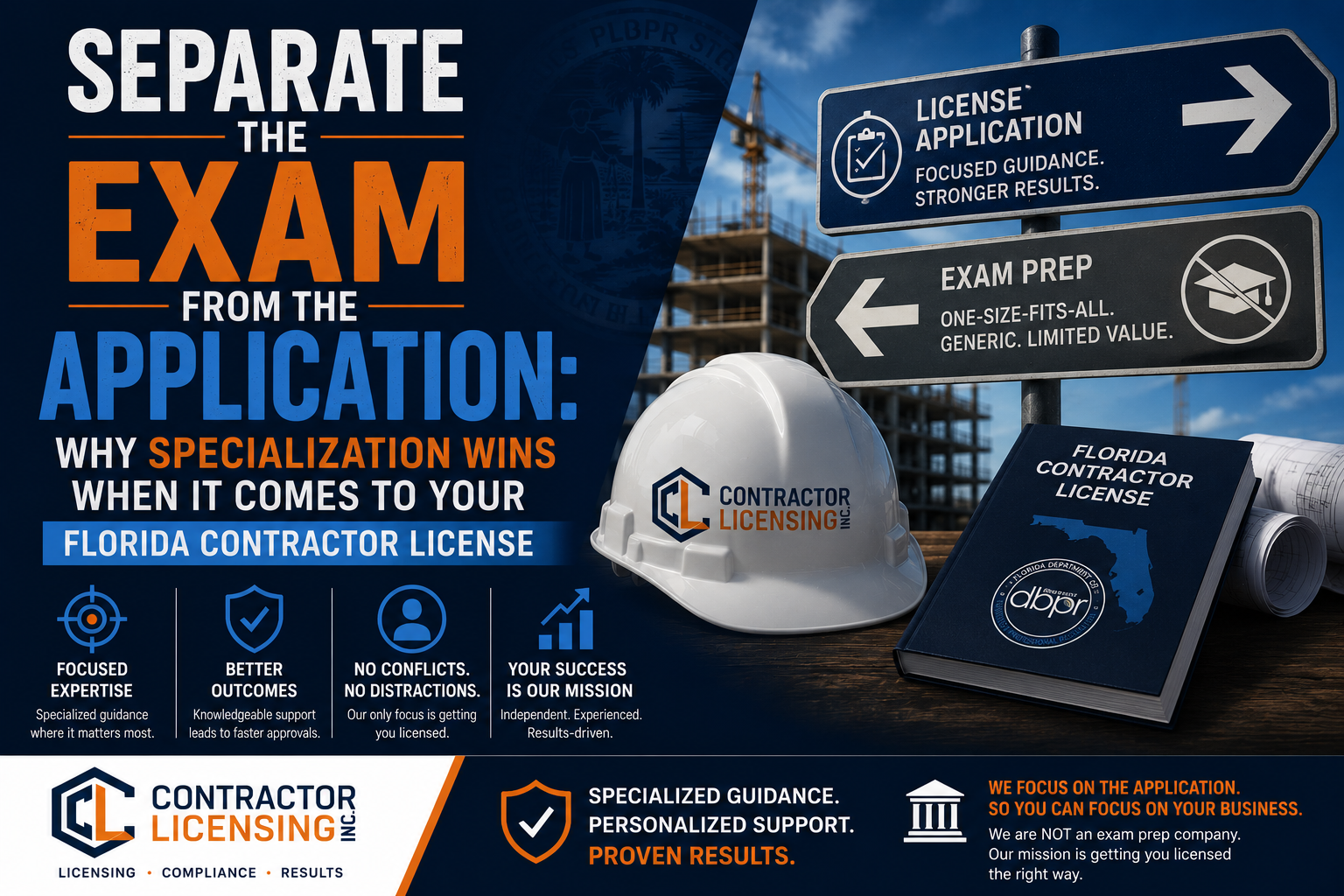
Contractor Licensing Inc. focuses exclusively on licensing — not exam prep, not book sales, not continuing education enrollment. Our entire business is getting contractors licensed through the DBPR accurately, efficiently, and with the institutional knowledge that comes from processing applications every single day.
Visit contractorlicensinginc.com or call our Florida office during business hours. Let us handle the part that matters most.
This article is for informational purposes only. Florida DBPR application requirements and CILB processes are subject to change. Always verify current requirements directly with the Florida DBPR.