The 13 Most Common Florida Contractor License Application Mistakes — And How to Avoid Every One
Nine out of ten Florida contractor license applications submitted without professional help come back with a deficiency letter. That’s not a statistic someone invented to sell services — it’s what happens when people underestimate how precise the DBPR’s review process actually is.
A deficiency doesn’t just mean a delay. It means your application stops completely, gets moved to the back of the examiner queue, and potentially misses the next CILB board meeting cutoff — adding 30 to 60 days to your timeline for each cycle you lose. Do that twice and you’re looking at four to six months before you’re licensed, instead of four to six weeks.
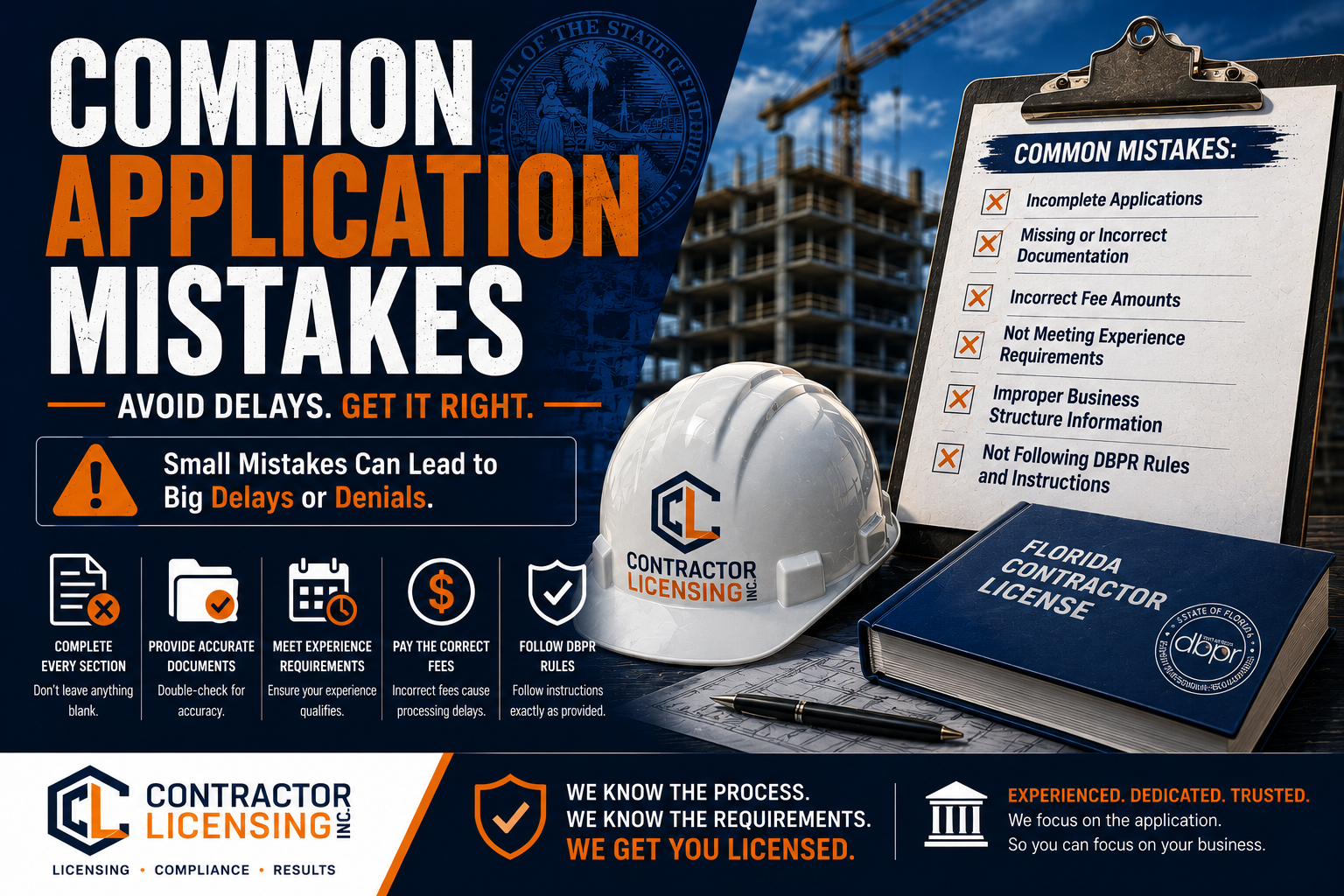
Every mistake on this list is avoidable. Most of them are made by people who are otherwise fully qualified for their license. Here’s exactly what to watch for.
Mistake 1: Vague Experience Descriptions
This is the single most common reason applications get flagged — and one of the most frustrating, because it’s entirely within the applicant’s control.
The DBPR doesn’t want to know that you “worked in construction” for four years. It wants to know what you built, what your role was, how many stories the structure was, what materials were involved, what decisions you made, and whether you were supervising others. The CILB 4359 experience verification form has fields for a reason — they exist because the board evaluates your experience against specific construction categories, and vague answers don’t satisfy those criteria.
Compare these two descriptions of the same job:
Weak: “Supervised construction work on commercial projects from 2019 to 2023.”
Strong: “Foreman on a 4-story, 34,000 sq ft tilt-wall commercial warehouse in Orange County. Managed a crew of 9, coordinated concrete, structural steel, and roofing subcontractors, responsible for daily scheduling, QC inspections, and punch list completion. Contract value approximately $2.8M.”
The second version gives the examiner everything they need to evaluate your experience against the license classification you’re applying for. The first version gives them a reason to send a deficiency letter asking for more detail.
Write every project description as if the examiner knows nothing about construction and nothing about you.
Mistake 2: Employment History Gaps
The DBPR expects your employment history to account for the entire qualifying period — four years — with no unexplained gaps exceeding 30 days. If you have a six-month gap in your work history with no explanation, an examiner will flag it.
Gaps happen. People take time off, change industries, deal with family situations, or run between jobs. None of those are automatic problems — but unexplained gaps are. Before you submit, map out your entire employment timeline and make sure every period is accounted for. If there’s a gap, include a brief written explanation. The board is not penalizing you for having a gap — they’re penalizing you for leaving one unexplained.
Also watch for the calendar math. The qualifying window requires experience within the last ten years. If your four years of experience spans a period that started more than ten years ago, you may not have enough qualifying experience within the window, even if your total career experience is extensive.
Mistake 3: Typos and Name Inconsistencies Across Documents
This sounds trivial. It is not.
Every name, every entity, and every address that appears on your application must be identical across all documents. Your DBPR application form, your insurance certificate, your Sunbiz registration, your CILB 4359 forms, your government-issued ID, and your business entity formation documents must all match exactly.
Common variations that cause deficiencies:
- “John A. Smith” on the application vs. “John Smith” on the insurance certificate
- “ABC Construction LLC” vs. “ABC Construction, LLC” (the comma matters to some systems)
- Middle initial included in one place, omitted in another
- Business address listed as a PO box on the COI but a physical address on the application
- Applicant’s name spelled differently on the application vs. the FDLE background check result
The DBPR’s review process involves cross-referencing multiple documents against each other. When names don’t match exactly, the examiner flags it as a potential discrepancy — which means a deficiency letter, not a phone call to ask if it’s the same person.
Before you submit, lay every document out side by side and verify that every name, address, and entity identifier is character-for-character identical.
Mistake 4: Not Disclosing Criminal History
This is one of the most serious mistakes on this list — and one of the most common.
Florida contractor license applications require full disclosure of all criminal history. That means all convictions, guilty pleas, and no-contest pleas, regardless of whether adjudication was withheld, regardless of how long ago the offense occurred, and regardless of whether you believe the record was expunged or sealed.
Applicants who omit criminal history — even minor, old, or seemingly irrelevant matters — face a far worse outcome than applicants who disclose and explain. When the DBPR’s FDLE background check turns up a conviction that doesn’t appear on your application, it’s not treated as an oversight. It’s treated as deliberate concealment — which is itself grounds for denial and can be treated as fraud.
The instinct to minimize or omit is understandable. But the CILB has approved licenses for applicants with serious criminal histories when those applicants disclosed fully, presented rehabilitation evidence, and gave the board the full picture. The same board has denied applications from people with minor offenses because those applicants tried to hide them.
Disclose everything. Then explain it well. Include a written statement describing the circumstances, what’s happened since, and why you are prepared to hold a contractor license responsibly.
Mistake 5: Criminal History That Doesn’t Match FDLE Records
Related to Mistake 4 but distinct: applicants sometimes disclose criminal history, but the details they provide don’t match what appears in the FDLE or court system records.
This happens when applicants rely on memory, summarize charges incorrectly, use informal language for formal charge names, or list a different disposition than what’s reflected in the court record. Even well-intentioned applicants who are trying to be transparent can create discrepancies that raise questions.
The fix: pull your own criminal history record before you apply. Florida residents can request a personal review of their FDLE criminal history through the FDLE’s Computerized Criminal History (CCH) system. Out-of-state convictions can be confirmed through the relevant state’s court records. Submit the disclosure using the exact charge names and dispositions that appear in the official record — not the informal name you’ve always used for it.
Mistake 6: Business Entity Not Registered or Not Matching
If you’re applying under a business entity — an LLC or corporation — that entity must be registered with the Florida Division of Corporations (Sunbiz) and must be in active good standing at the time of application.
Common problems:
- The entity hasn’t been formed yet when the application is submitted
- The entity is formed under a slightly different name than what’s on the application
- The entity is registered but listed as “inactive” or “dissolved” in Sunbiz
- Out-of-state companies haven’t filed as a foreign entity authorized to do business in Florida
- The registered agent information in Sunbiz is outdated
The DBPR cross-references Sunbiz records during application review. If the entity on your application doesn’t appear in Sunbiz exactly as listed, or if it’s not in good standing, it generates a deficiency. Check your Sunbiz status before submitting — it takes about two minutes at sunbiz.org and can prevent a 30-day delay.
Mistake 7: Insurance Certificates That Don’t Match
Your insurance certificate must meet several specific requirements, and small deviations from those requirements generate deficiencies at a high rate.
Common insurance certificate mistakes:
- The insured name on the COI doesn’t match your entity name or your applicant name exactly
- Coverage amounts don’t meet the DBPR’s minimum thresholds ($300,000 general liability for most certified contractor classifications)
- The certificate was obtained from the subcontractor rather than directly from the insurer — these are more likely to have discrepancies
- Workers’ compensation coverage isn’t included or the exemption documentation is missing
- The DBPR or CILB is not listed as the certificate holder in the required format
- Policy dates don’t cover the application period
Get your COI directly from your insurance carrier or agent — not a copy handed to you. Then verify that every field matches your application exactly.
Mistake 8: Fingerprints Submitted at the Wrong Time
Florida requires electronic fingerprints (Livescan) from all contractor license applicants through an FDLE-approved Livescan provider. What many applicants don’t know is that fingerprints should be submitted after the application is filed — not before.
Submitting fingerprints too early can result in results that expire or get processed without being linked to your pending application. Submitting too late creates a delay in the background check phase of review. The DBPR provides fingerprinting instructions with the application confirmation — follow those instructions precisely, use an FDLE-approved provider, and submit only after you have your application number.
Also: fingerprint results flow directly from FDLE to DBPR. The portal may show “deficient” for fingerprints while results are still being processed. This is a processing status, not a deficiency finding. Don’t panic or try to get re-fingerprinted unless you receive a formal deficiency letter.
Mistake 9: Applying for the Wrong License Classification
Florida has dozens of contractor license classifications with different scopes of work, experience requirements, and application forms. Applying for the wrong one — most commonly applying for a Certified General Contractor (CGC) when your experience only supports a Certified Building Contractor (CBC) or Certified Residential Contractor (CRC) — results in a denial that can’t be corrected through a deficiency response.
The classification decision needs to be made correctly before you submit. Review the scope of work for the license you’re targeting against your actual documented experience. The CILB applications for CGC, CBC, and CRC are different forms (CILB 5-A for General, with parallel forms for other classifications). Submitting the wrong form or checking the wrong classification box creates a problem that goes deeper than a missing document.
Mistake 10: Financial Statement Errors and Credit Issues Without Explanation
The DBPR reviews your credit report as part of the financial responsibility requirement. A minimum FICO score of 660 is the published threshold — applicants below that threshold are required to complete a 14-hour financial responsibility course before the application can move forward.
But beyond the score threshold, the CILB looks at the full credit picture. Unresolved judgments, tax liens, active collections, or a recent bankruptcy require more than just meeting the minimum score. They require explanation, documentation of resolution or active repayment plans, and in some cases a board hearing.
Applicants who submit without addressing known credit issues — hoping the examiner won’t notice — almost always receive a deficiency. The board has reviewed thousands of credit reports and knows what to look for.
If you have negative credit items, address them proactively: include a written explanation with each item, documentation showing resolution or payment status, and any relevant context. A transparent application with a known credit issue and strong supporting context performs far better than an application that tries to slide through without acknowledging it.
Mistake 11: The CILB 4359 Completed by the Applicant
The DBPR CILB 4359 — Verification of Construction Experience form must be completed and signed by your supervising contractor — not by you. The CILB specifically watches for forms that appear to have been filled out by the applicant rather than the supervisor, and rejects them.
This is a hard rule. The form must reflect the supervisor’s firsthand knowledge of your work. In many cases it must be notarized. If you draft the content and hand it to the supervisor to sign, that creates risk — both of rejection if it’s flagged, and of misrepresentation if the supervisor is affirming content they didn’t personally write.
Have each qualifying supervisor complete the form in their own words, with their direct knowledge of your role and projects. You can provide general guidance on what information is needed, but the form must genuinely represent the supervisor’s attestation, not yours.
Mistake 12: Missing Signatures, Outdated Forms, and Unsigned Sections
The DBPR will not flag these for you before returning your application. If you miss a signature line, leave a required section blank, or submit an older version of a form that’s since been updated, you’ll receive a deficiency letter — and your application goes to the back of the line.
Before submitting:
- Confirm you are using the current version of every DBPR form (check myfloridalicense.com for the most recent versions — forms are updated periodically and older versions are not accepted)
- Sign and date every required signature line
- Complete every required field — if a field doesn’t apply, write “N/A” rather than leaving it blank
- Have a second set of eyes review the completed package before submission
One missed signature on a 12-page application is enough to generate a deficiency letter and a 30-to-45-day delay.
Mistake 13: Underestimating the Board Meeting Calendar
This isn’t a documentation mistake — it’s a timing mistake that no amount of careful preparation fully protects against. But understanding it can prevent an unnecessary month-long delay.
The CILB meets monthly to review applications that require board-level consideration. Each meeting has a submission cutoff — applications must be fully reviewed by DBPR examiners and prepared for the board agenda by a specific date. If your application clears the examiner review just after that cutoff, it rolls to the following month’s meeting.
If your application also requires a deficiency response — and the response arrives after the cutoff for the next meeting — you lose another full cycle.
The practical implication: every deficiency cycle that overlaps a board cutoff costs you 30 days. A clean application submitted at the right point in the calendar can be approved in four to six weeks. The same application with two deficiency cycles can take four to five months.
The best protection is submitting a complete, deficiency-free application. The second-best protection is working with a licensing service that tracks the CILB calendar and knows how to time submissions.
The Real Cost of a Deficiency Letter
Every deficiency restarts the clock. Once you respond to a deficiency letter, your application doesn’t return to the top of the queue — it enters the back of the line for re-review, which takes another 30 to 45 days. If the re-review then misses the CILB meeting cutoff, add another full month.
Two deficiency cycles on a board-track application is six months of delay. On a project timeline where you need to be licensed to pull permits and sign contracts, that’s not an administrative inconvenience — it’s a business problem.
Getting the application right the first time isn’t about perfectionism. It’s about protecting the timeline that your business depends on.
Frequently Asked Questions
What is the most common reason Florida contractor license applications get rejected? Incomplete or vague experience documentation is the leading cause. The DBPR requires specific, detailed descriptions of project types, applicant roles, crew sizes, and relevant construction categories — not general statements about working in construction. Inconsistent names across documents and undisclosed criminal history are the next most common causes.
What happens if I make a mistake on my Florida contractor license application? The DBPR issues a formal deficiency letter identifying what needs to be corrected. Your application stops processing until you respond. Responses take 30 to 45 days to be reviewed after submission, and each deficiency cycle that misses a CILB board meeting cutoff adds another 30 days. Deficiencies cannot be corrected by phone — they require a formal written response submitted to the DBPR.
Can I reuse an old DBPR application form? No. DBPR forms are updated periodically and the CILB requires current versions. Submitting an outdated form generates an immediate deficiency. Always download forms directly from myfloridalicense.com before preparing your application to ensure you have the current version.
What if my former employer is unavailable to complete the CILB 4359? If a supervisor is unavailable, deceased, or the company is no longer in business, the DBPR has alternative documentation pathways — tax records, project records, client affidavits, and a written explanation of why standard verification couldn’t be obtained. Contact the DBPR directly or work with a licensing specialist to identify what alternatives will be accepted for your specific situation.
Do I need to disclose criminal history even if it was expunged? Florida contractor license applications require disclosure of all convictions, pleas, and criminal matters — including those that were expunged or for which adjudication was withheld. The FDLE background check reflects records that may not appear in public court databases. Undisclosed history that appears on the FDLE check is treated as deliberate concealment, which is grounds for denial regardless of the underlying offense.
Get It Right the First Time
Every mistake on this list is preventable. Most of them don’t require specialized knowledge — they require thoroughness, consistency, and an understanding of what the DBPR is actually looking for.
The contractors who get through the process in four to six weeks are the ones whose applications were built correctly before submission. A missed signature or a name mismatch that takes 30 seconds to fix in advance becomes a 45-day delay after the fact.
Contractor Licensing Inc. reviews every application for exactly these issues before submission. We know what examiners flag, how to document experience in the language the board expects, how to address criminal history and credit issues proactively, and how to ensure that every name, every entity, and every document in your package is consistent from the first page to the last.
Visit contractorlicensinginc.com or call our Florida office during business hours to start the process right.
This article is for informational purposes only and does not constitute legal advice. Florida DBPR and CILB application requirements are subject to change. Always verify current requirements directly with the DBPR at myfloridalicense.com.