
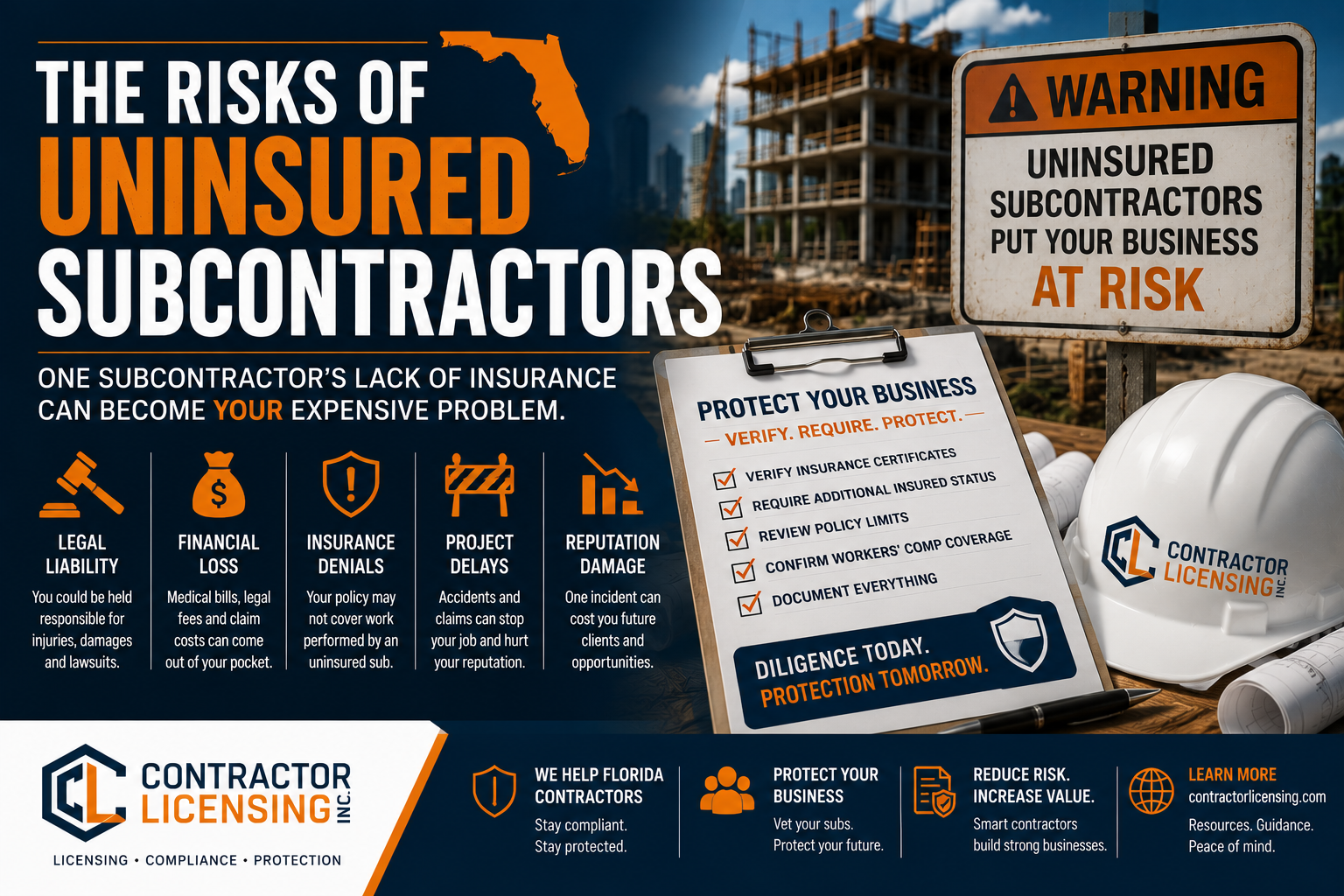
In our last article, we covered what happens when you hire an unlicensed subcontractor in Florida. But there’s a parallel risk that catches even experienced contractors off guard — and it can be just as devastating: the uninsured subcontractor.
A subcontractor can be fully licensed and still carry zero insurance. They can hand you a certificate of insurance that turns out to be fraudulent, expired, or simply inadequate for the work being performed. And when something goes wrong on your job site — an injury, property damage, a workers’ comp audit — the financial exposure lands on you.
This guide covers the full picture: what Florida law requires, what happens when a sub has no coverage, how insurance audits trigger surprise bills, how your own policies may fail you, and what you need to do before any subcontractor sets foot on your project.
What Florida Law Requires from Subcontractors
Florida has some of the strictest workers’ compensation laws in the country — and construction is the most tightly regulated industry under those laws.
Florida Statute §440.10 is the foundation. Under this statute, any contractor or subcontractor engaged in public or private construction must secure and maintain workers’ compensation for their employees. The statute goes further: when you sublet work to a subcontractor, all employees of both your company and that sub are deemed to work in “one and the same establishment.” That means if the sub fails to carry coverage and one of their workers is injured, the liability moves uphill — directly to you.
The statute is straightforward in its application: the injured worker falls first toward the subcontractor’s policy. If that policy doesn’t exist or isn’t valid, the fall doesn’t stop. Florida law pushes the obligation up to the contractor who hired them.
Florida Statute §440.107 gives the Florida Department of Financial Services (DFS) authority to enforce workers’ comp compliance. This includes the power to enter your business — without a warrant — to demand records, and to issue Stop-Work Orders immediately if coverage is found to be missing or inadequate. The legislature has designated a lack of workers’ comp coverage as “an immediate danger to public health, safety, and welfare.” That’s not cautionary language. It’s the statutory basis for shutting your project down on the spot.
Does a Subcontractor Need Workers’ Comp in Florida?
Yes — with limited, specific exceptions. Every subcontractor engaged in Florida construction work must either:
- Carry an active workers’ compensation policy covering their employees, or
- Hold a valid Certificate of Election to Be Exempt for qualifying owners and officers
The exemption option is narrower than most contractors realize. In Florida construction:
- Corporate officers of a corporation may apply for an exemption — but the exemption covers only the named individual, not any workers they bring to the job
- Sole proprietors and partners may also exempt themselves in some classifications
- Roofing is specifically excluded — there are no valid workers’ comp exemptions for roofing subcontractors in Florida. Any roofing sub who claims an exemption is wrong or misrepresenting their status. Full stop.
Calling someone a 1099 independent contractor does not eliminate your workers’ comp obligation. Florida Admin Code Rule 69L-6.032 is explicit: the label on a payment — W-2 or 1099 — does not determine workers’ comp coverage requirements. What matters is whether the individual is performing construction work on your project. If they are, coverage must be in place.
The Statutory Employer Doctrine: How You Become Liable for Someone Else’s Worker
The statutory employer doctrine under §440.10 is the mechanism that makes uninsured subcontractor problems personal. Here is how it works in practice:
A licensed plumbing subcontractor sends a two-man crew to your job site. They’re 1099 workers. The sub has no active workers’ comp policy. One of the workers falls from a ladder and suffers a serious back injury — surgery, six weeks off work, and permanent partial impairment.
The worker’s claim goes to the subcontractor’s insurer. There is no insurer. The claim then goes up the chain to you as the general contractor. Under §440.10, you are the statutory employer. You are liable for:
- Medical expenses from day one through maximum medical improvement
- Lost wages during recovery
- Permanent impairment benefits
- Potential death benefits if the injury is fatal
A serious construction injury claim in Florida routinely exceeds $200,000. Catastrophic injuries — falls from roofs, structural collapses, severe burns — frequently exceed $1 million. That exposure lands entirely on your business if the sub had no coverage and your own policy excludes the claim.
Watch out for helpers. If an exempt sole proprietor brings a worker, friend, or assistant to your job site, the exemption covers only the named individual. The moment that additional person steps onto your site, you are exposed for any injury they suffer. Verify that every individual on site — not just the sub company — has appropriate coverage or a valid exemption.
What Happens If a Subcontractor Doesn’t Have Insurance: The Workers’ Comp Audit
Many contractors discover their uninsured subcontractor problem not at the time of an injury — but months later, when the workers’ comp audit arrives.
Here’s how the trap works:
Your workers’ compensation insurer estimates your payroll at the start of each policy year and charges premium accordingly. At the end of the policy year, they conduct a premium audit to reconcile what was actually paid. For Florida construction contractors with premiums exceeding $10,000, this audit is required by law to be a physical, on-site audit every year.
During that audit, the auditor isn’t just looking at your payroll journal. They’re looking at every subcontractor invoice you paid. If they find payments to subcontractors who cannot provide proof of their own workers’ comp coverage, those subcontractor payments get added to your payroll and charged at your class code rates.
Florida construction class codes — particularly for roofing, framing, concrete, and other high-hazard trades — carry high premium rates. A single uninsured roofing subcontractor who did $80,000 in work on your projects could generate a surprise audit bill of $10,000 to $20,000 or more, depending on your experience modifier.
And it compounds. Once an uninsured sub claim appears on your record, your experience modifier (mod) increases. A higher mod means higher premiums across your entire workers’ comp policy for the next three years — not just on the project where the problem occurred.
If the DFS Division of Workers’ Compensation — rather than your carrier — conducts the investigation, the penalties are steeper. Under §440.107(7)(d), the penalty is 2 times the amount you would have paid in premium for the uninsured period, applied against the subcontractor’s full contract price at applicable rates. Minimum penalty: $1,000. For repeat violations or concealment of payroll, the lookback period extends to 24 months.
General Liability: When Your CGL Policy Won’t Cover You Either
Uninsured subcontractors create gaps in your general liability coverage that most contractors don’t discover until a claim is denied.
Standard commercial general liability (CGL) policies contain several exclusions that apply directly to subcontractor situations:
The “Your Work” Exclusion (ISO j(6)): Your CGL policy generally won’t pay to repair or replace defective work performed by your subcontractors. It may cover resulting damage — a fire caused by faulty wiring — but not the cost of tearing out and redoing the defective work itself. When the sub is uninsured, there’s no second policy to cover the gap.
The Subcontractor Exclusion: Many CGL policies contain endorsements — such as ISO CG 22 94, “Exclusion — Damage to Work Performed by Subcontractors on Your Behalf” — that specifically remove coverage for property damage caused by a subcontractor’s faulty work. If that sub is uninsured and the damage claim exceeds what your policy covers, you pay the difference personally.
Completed Operations: Additional insured endorsements on subcontractor COIs come in different forms. CG 20 10 covers ongoing operations; CG 20 37 covers completed operations after the project is done. Many subcontractors provide only CG 20 10, leaving you exposed to claims that arise after project completion. If the sub is uninsured when the claim arises, you have no coverage from either direction.
Vicarious liability applies whenever a sub causes harm and lacks coverage. If their work injures a third party — a visitor, a neighboring property owner, a future occupant — the injured party can pursue a claim against you. Without an insured sub to share or absorb the claim, your policy becomes the only source of recovery. If your policy then applies an exclusion, you are personally exposed.
Industry research indicates that up to 22% of certificates of insurance submitted by subcontractors are invalid — expired, covering the wrong entity, or reflecting coverage that has since lapsed. A COI is a snapshot. It is not a guarantee of active coverage on the day work is performed.
Contractor Lied About Insurance: What You Can Do
It happens more often than contractors expect. A subcontractor submits a certificate of insurance that is fraudulent, altered, or references a policy that has already been cancelled.
If you discover that a subcontractor misrepresented their insurance status:
- Document everything immediately: Preserve all contracts, COIs, communications, and invoices related to that subcontractor
- Stop the work: Remove the sub from your project immediately and document the termination in writing
- Notify your carrier: Report the situation to both your CGL and workers’ comp insurers. Failure to notify promptly can be a policy breach
- Pursue the sub through your contract: If your subcontract includes a license and insurance warranty clause and an indemnification provision, you have a contractual basis to pursue the sub for any losses you sustain — including audit charges, claim costs, and legal fees
- Report COI fraud: Fraudulent certificates of insurance can constitute insurance fraud under Florida law. Depending on the circumstances, reporting to the DBPR or law enforcement may be appropriate
- Consult legal counsel: Particularly if a worker has been injured, get a Florida construction law attorney involved before making any statements to the worker, the state, or your carrier
How to Verify Subcontractor Insurance — the Right Way
Collecting a certificate of insurance is not the same as verifying insurance. A COI is only a summary. The underlying policy controls. Here is how to do verification properly:
Step 1 — Request the certificate from the insurer, not the sub. Ask the sub’s insurance agent or carrier to send the COI directly to you. COIs provided by the subcontractor can be altered. A COI issued directly by the insurer to you as certificate holder is significantly more reliable.
Step 2 — Verify the certificate against the Florida DFS Proof of Coverage database. The Florida Department of Financial Services maintains a workers’ comp proof-of-coverage database at myfloridacfo.com/division/wc/employer. You can confirm whether a policy is actually active for a specific employer — independent of any paper certificate they hand you.
Step 3 — Confirm the insured name exactly matches your subcontract. The legal name on the certificate must match the entity you are contracting with — exactly. Name variations between the COI and your subcontract are a red flag. Insurance coverage does not automatically transfer between related entities.
Step 4 — Check policy dates against the project schedule. Coverage must be active through the completion of the work. A policy that expires mid-project creates an uninsured window. Require renewal certificates before the expiration date.
Step 5 — Confirm you are named as an additional insured. For general liability, confirm both CG 20 10 (ongoing operations) and CG 20 37 (completed operations) endorsements naming your company. For workers’ comp, confirm the waiver of subrogation.
Step 6 — Build a COI file for every project. Keep a folder — physical or digital — for every project with current COIs from every subcontractor on that job. When an audit arrives, this file is what stands between you and a massive retroactive premium bill.
Are Subcontractors Liable for Damages? Understanding Your Recourse
As the general contractor or prime contractor, you bear ultimate responsibility for the work performed on your project. That doesn’t mean you have no recourse against a subcontractor whose uninsured status caused you harm — but your recourse depends entirely on what you put in writing before work began.
A properly drafted subcontract should include:
- Insurance warranty: Sub warrants active coverage at specified limits throughout the project, with 30-day cancellation notice to you
- Indemnification clause: Sub indemnifies you for all losses, claims, penalties, and audit charges arising from their failure to maintain required coverage
- Additional insured requirement: You must be named as additional insured on both CGL policies (ongoing and completed operations) and receive written confirmation
- Right to withhold payment: You reserve the right to withhold payment pending verification of current, valid coverage
- General contractor responsible for subcontractor negligence: Make clear in the subcontract that the sub is solely responsible for their own employees’ acts, omissions, and compliance — and that your payment of any claim on their behalf creates a debt they owe you
Without these provisions in writing, your ability to recover from the sub for losses caused by their uninsured status is limited to whatever tort claims survive litigation — expensive, uncertain, and slow.
Legal and Compliance Considerations
1099 language does not create insurance protection. Paying a sub by 1099 does not eliminate your workers’ comp exposure under Florida §440.10. The statutory employer doctrine applies regardless of how the payment is classified.
Exemptions are individual, not organizational. A corporate officer exemption covers only the named officer. Any workers brought to your site by an exempt sole proprietor are not covered by the exemption.
Stop-Work Orders are immediate and public. A DFS Stop-Work Order halts all construction on your project until compliance is demonstrated and a penalty bond is posted. The order is public record and can affect your ability to bid future work, maintain bonding, and renew your contractor license.
Subcontractor insurance lapses can happen mid-project. A valid COI on day one does not guarantee coverage on day 90. Set calendar reminders for policy expiration dates and require updated certificates before renewal gaps occur.
Fraudulent COIs are more common than most contractors expect. Industry data suggests up to 22% of submitted certificates contain some deficiency. Verification through the DFS database is the only reliable confirmation of active workers’ comp coverage.
Frequently Asked Questions
What happens if my subcontractor doesn’t have insurance and someone gets hurt? Under Florida Statute §440.10, you become the statutory employer and are liable for the injured worker’s medical expenses, lost wages, and impairment benefits. If your workers’ comp policy excludes uninsured subs — which many do — you face that exposure personally. The financial impact on a serious injury claim routinely exceeds $200,000.
What if a subcontractor doesn’t have insurance but claims to be an independent contractor? The independent contractor label doesn’t override Florida’s workers’ comp requirements in construction. If the individual is performing construction work on your project and doesn’t carry their own coverage or have a valid exemption, the statutory employer obligation falls on you.
Can a contractor sue a subcontractor for damages caused by lack of insurance? Yes — if your subcontract includes an indemnification clause and an insurance warranty. Without those provisions in writing, your recourse is limited to general tort claims, which are significantly harder to pursue. This is why strong subcontract language isn’t optional.
What happens if I get caught in a Florida workers’ comp audit with uninsured subs? Your carrier adds the sub’s payments to your audited payroll and charges premium retroactively at your class code rates. If the DFS is conducting the audit, the penalty is 2x the premium that should have been paid, minimum $1,000. For repeat violations, the lookback period extends to 24 months. A Stop-Work Order may also be issued.
Does hiring a contractor without insurance put me personally at risk? Yes. If your business entity doesn’t have sufficient assets to cover the exposure, personal liability can follow depending on your business structure and the specific circumstances. For sole proprietors, personal asset exposure is direct. Even for corporate entities, piercing of the corporate veil is possible in fraud or gross negligence situations.
The Bottom Line: Insurance Verification Is Not Optional
The cost of an uninsured subcontractor on a Florida construction project is not theoretical. It shows up in audit bills, injury claims, policy cancellations, Stop-Work Orders, and premium increases that follow your business for years. The contractor who saves $5,000 by using an uninsured sub and then faces a $200,000 workers’ comp claim has made a catastrophic miscalculation.
The fix is straightforward: verify workers’ comp through the DFS database before work starts, collect COIs directly from insurers, build a COI file for every project, and include insurance warranty and indemnification provisions in every subcontract.
Contractor Licensing Inc. and Artisan Insurance Inc. help Florida contractors build the compliance systems that prevent these problems — from subcontract language to insurance verification processes to licensing compliance across multiple states. If you’re not sure your current process is protecting you, it probably isn’t.
Visit contractorlicensinginc.com or call our Florida office during business hours to talk through your subcontractor compliance needs.
This article is for informational purposes only and does not constitute legal or insurance advice. Florida workers’ compensation requirements are subject to change. Always verify current requirements with the Florida Department of Financial Services, your licensed insurance broker, and a qualified Florida construction law attorney.