Unlicensed Subcontractors in Florida: What Every Licensed Contractor Needs to Know
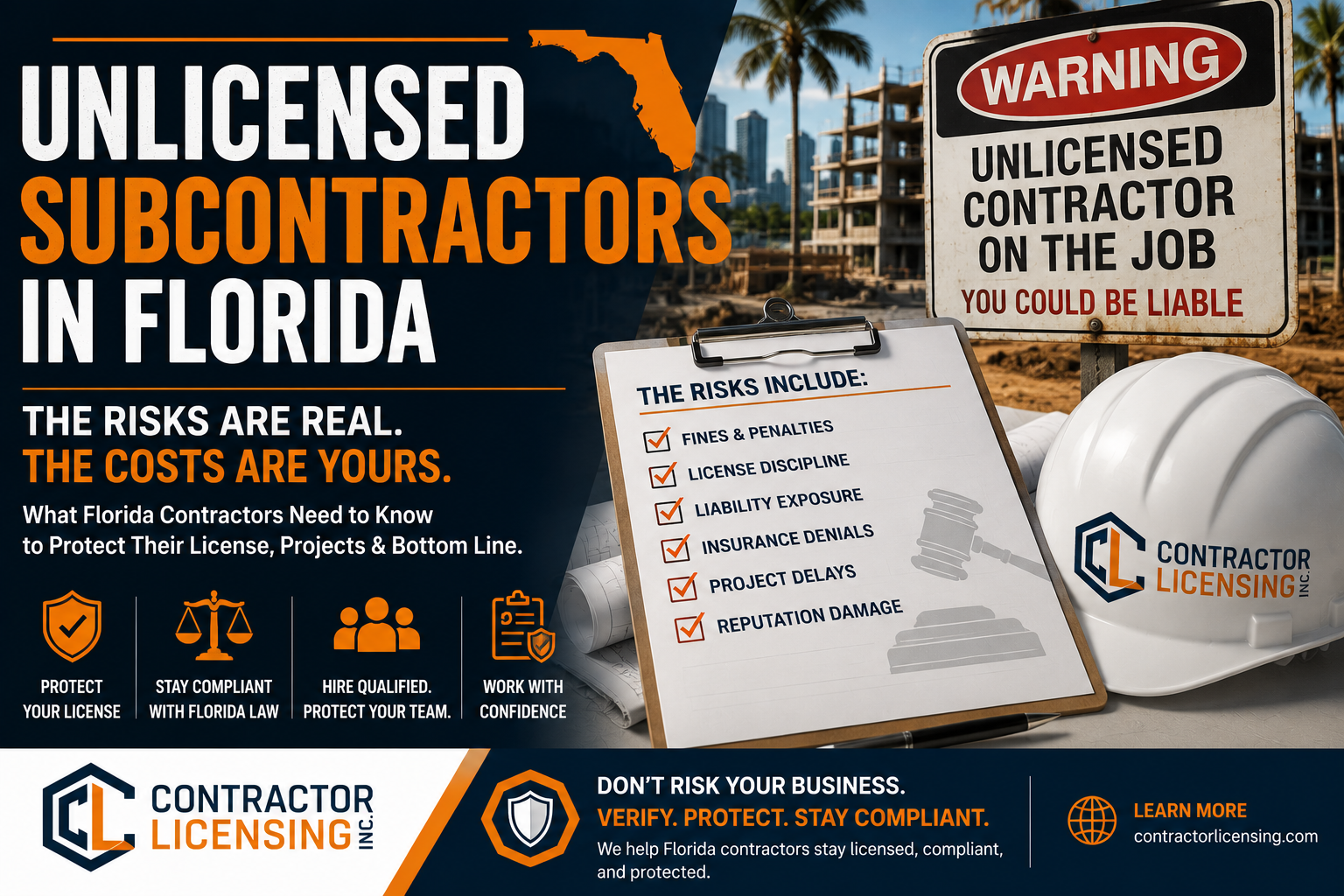
Using an unlicensed subcontractor in Florida might seem like a minor shortcut — a way to cut costs, fill a crew gap, or move a project faster. In practice, it’s one of the most dangerous decisions a licensed Florida contractor can make. The consequences reach far beyond a simple fine: your license is at risk, your insurance may not cover you, your contracts may become unenforceable, and if someone gets hurt, you could be personally on the hook for every dollar.
This guide covers what Florida law says about unlicensed subcontractors, what happens to licensed contractors who use them, and exactly what you need to do to protect yourself — every project, every time.
Do Subcontractors Need a License in Florida?
Yes — with narrow exceptions. Under Florida Statute Chapter 489, any person or business entity that performs, offers to perform, or advertises contracting services for compensation must hold a valid Florida license for the scope of work being performed. This applies to subcontractors just as it applies to prime contractors.
The license requirement covers virtually all regulated construction work: general contracting, roofing, plumbing, electrical, HVAC, underground utility, specialty trades, and more. The only work that falls outside the licensing requirement is a narrow set of tasks — cabinet installation, flooring, painting, window treatments — that the DBPR specifically excludes. For everything else on a typical commercial or residential project, a license is required.
One critical point under Florida Statute §489.127: a contractor operating on an inactive or suspended license is legally considered unlicensed. A business tax receipt is not a license. A license number that expired last month is not a valid credential. When you verify a subcontractor’s status, you’re checking current, active licensure — not just whether they once held a license.
The Risk to Your License: What the CILB Can Do
This is the exposure most licensed contractors underestimate. When you hire an unlicensed subcontractor, your license is at risk — not just the sub’s.
Florida Statute §489.129 gives the Construction Industry Licensing Board broad disciplinary authority over licensed contractors who use unlicensed subs. The CILB’s standard is whether you “knew or should have known” that the subcontractor was unlicensed. Given that license verification takes two minutes at myfloridalicense.com, failure to check is routinely treated as willful negligence in board hearings — not an honest mistake.
Disciplinary actions available to the CILB include:
- Administrative fines up to $10,000 per violation — and each project or each unlicensed sub can constitute a separate violation
- Probationary license status with mandatory oversight and supervision requirements
- License suspension — typically ranging from 6 months to 2 years
- License revocation — permanent loss of your Florida contracting license
- Mandatory restitution to consumers harmed by the unlicensed work
- Continuing education requirements as a condition of reinstatement
Every disciplinary action issued by the CILB becomes public record. That record follows your license permanently — affecting your ability to bond projects, bid on commercial work, and maintain your professional reputation in the market.
Criminal Exposure: More Serious Than Most Contractors Realize
Florida treats unlicensed contracting as a criminal matter, not just a regulatory one. Under §489.127, the penalties are:
- First offense: First-degree misdemeanor — up to one year in jail, 12 months probation, and a $1,000 fine
- Repeat offenses: Third-degree felony — up to five years in prison or probation and a $5,000 fine
- During a declared state of emergency (post-hurricane, for example): Automatic third-degree felony even for a first offense
For licensed contractors, the criminal exposure comes from aiding or abetting unlicensed activity — which includes hiring a known unlicensed sub, pulling permits for unlicensed work, or allowing unlicensed activity to continue on your job site once discovered.
Beyond jail time and fines, criminal convictions in Florida’s construction trades can result in a permanent bar from obtaining or holding a Florida contractor license. For a working contractor, that’s the end of the business.
Your Contracts May Become Unenforceable
This is a consequence many contractors don’t see coming until they’re in a dispute.
Florida Statute §489.128 states that contracts entered into by unlicensed contractors are unenforceable in law or in equity. On its face, this protects property owners from having to pay unlicensed subs. But it creates a serious problem for licensed prime contractors who used those subs.
If an unlicensed subcontractor performs defective work and you want to pursue them for damages — you may have no contractual remedy. Courts generally won’t enforce either side of a contract tainted by unlicensed work. Your only path may be a costly, uncertain tort claim rather than a straightforward breach of contract action.
At the same time, unlicensed contractors have no lien rights in Florida. Under §713.02(7), no lien exists in favor of any contractor, subcontractor, or sub-subcontractor who is unlicensed. They also lose their bond claims. While this sounds like protection for you, it also means the legal structure that normally governs subcontractor relationships and payment disputes simply doesn’t function when licensure is absent.
How Enforcement Actually Happens
The Florida DBPR’s Division of Professions actively investigates unlicensed contractor activity. Enforcement is year-round, but intensifies significantly after major storm events when out-of-state operators flood the market. As a licensed contractor, you are not a bystander in that enforcement landscape — you’re a target if your subs aren’t verified.
Common triggers for CILB investigations involving licensed contractors:
- Homeowner or property owner complaints filed with the DBPR — the most frequent trigger
- Building inspectors who flag unlicensed work on a permit record
- Workers’ compensation audits that identify uninsured subcontractor labor
- OSHA inspections that reveal unlicensed trade work
- Insurance company subrogation investigations following a claim denial
- Tips from competitors or former employees
- Permit records that don’t match the licensed qualifier on file
The CILB does not require proof that you actively knew your sub was unlicensed. If you failed to verify and a complaint is filed, the burden shifts to you to demonstrate that you took reasonable steps. Without documented verification, that’s a difficult case to make.
Florida Statute 489.128 and the Homeowners Construction Recovery Fund
When an unlicensed subcontractor causes financial harm to a property owner, the damage flows upward. As the licensed contractor of record, you bear responsibility for the work performed on your project — regardless of who actually did it.
Florida provides limited recourse to harmed consumers through the Florida Homeowners Construction Recovery Fund, which can provide relief to homeowners damaged by licensed contractors who commit fraud, misrepresentation, or breach of contract. For homeowners hurt by unlicensed work on your project, you — the licensed contractor — are the party they can pursue through the fund and through civil litigation.
That exposure is real. Restitution orders from CILB proceedings, combined with civil judgments, can reach tens or hundreds of thousands of dollars depending on the scope of the defective or incomplete work.
How to Verify a Subcontractor’s License in Florida
The DBPR makes verification straightforward. There’s no excuse for skipping it.
Go to myfloridalicense.com and use the “Verify a License” search. You can search by name, license number, or business name. The database is free, real-time, and covers all state-certified and registered contractors in Florida.
When reviewing results, check:
- Status: Must show “Current, Active” — Delinquent, Inactive, Suspended, or Revoked all mean the sub cannot legally perform regulated work
- License type: Confirms they’re licensed for the specific scope of work you’re hiring them to perform
- License prefix: “C” prefix (CGC, CCC, CBC, etc.) = valid statewide; “R” prefix = valid in one local jurisdiction only
- Disciplinary history: A pattern of complaints or recent suspension is a red flag regardless of current status
- Expiration date: Even an active license that expires mid-project creates a compliance gap
Save the result. Print or screenshot the verification with the date and time visible. This is your documented proof that you verified the license before work began. In a CILB hearing, that record is the difference between a mitigated outcome and maximum penalties.
Note on HB 735 (effective July 1, 2025): The local registered contractor pathway has been eliminated for most license types. All new contractors must now obtain a state Certified license through DBPR. If a sub presents a local competency card as their credential, verify its status with the local building department and confirm whether it remains valid under the new framework.
What to Include in Every Subcontract
Documentation doesn’t stop at license verification. Your subcontract itself should include language that creates a clear compliance obligation and provides recourse if that obligation is breached.
Every subcontract should include:
- License Warranty Clause: Sub warrants it holds all required Florida licenses and will maintain them for the duration of the project. Misrepresentation of license status is grounds for immediate termination and triggers indemnification obligations.
- Insurance Maintenance: Sub must carry active general liability and workers’ compensation coverage meeting specified minimums. You must be named as an additional insured. Sub must provide 30-day notice of any cancellation.
- Right to Audit: You reserve the right to verify license and insurance status at any point during the project.
- Indemnification: Sub indemnifies and holds you harmless from fines, penalties, claims, or damages arising from its failure to maintain required licensure or coverage.
- No Further Subcontracting: Sub may not subcontract any portion of the work without your written approval — preventing unlicensed sub-subcontractors from entering the project.
- Flow-Down Clause: Any sub-subcontractors must meet the same licensing and insurance requirements you impose on the direct sub.
A contract that addresses these issues upfront doesn’t prevent all problems — but it creates legal recourse, establishes clear expectations, and demonstrates to the CILB that you operate a compliance-focused business.
Legal and Compliance Considerations
“I didn’t know” is not a defense. Florida’s CILB uses a “knew or should have known” standard. Failing to verify a subcontractor’s license status through a free, two-minute database search is treated as willful negligence by hearing officers — not an honest oversight.
An expired or inactive license equals unlicensed. Under §489.127, any contractor operating on an inactive or suspended certificate is legally considered unlicensed. Verify status immediately before each project, not just at the beginning of a business relationship.
Aiding unlicensed activity is its own violation. Pulling a permit for work you know will be performed by an unlicensed sub is not a workaround — it’s a separate CILB violation. The board specifically monitors for this pattern.
DBPR complaints are public record. Any complaint filed against your license — including those later resolved in your favor — may appear in public records searches. The reputational and bonding implications extend beyond the penalty itself.
Post-storm enforcement is heightened. Florida’s enforcement environment intensifies after declared emergencies. Contractors who expand capacity to meet post-disaster demand by using unverified labor are operating in the highest-enforcement window of any given year.
Frequently Asked Questions
Can an unlicensed contractor file a lien in Florida? No. Under Florida Statute §713.02(7), unlicensed contractors, subcontractors, and sub-subcontractors have no lien rights in Florida. They also forfeit bond claims. The lien and bond protections that normally secure payment in the construction industry simply don’t apply to unlicensed work.
Can I get in trouble for hiring an unlicensed contractor if I didn’t know they were unlicensed? Yes. The CILB standard is whether you “knew or should have known” — and the board consistently finds that a licensed contractor who failed to verify license status through the DBPR’s free online database “should have known.” Documented verification is your only real protection.
What happens if an unlicensed contractor sues me for payment? Under §489.128, contracts entered into by unlicensed contractors are unenforceable. The sub generally cannot successfully sue you for payment in Florida courts. However, this doesn’t mean the situation is cost-free — you may still face legal fees defending a claim, and the work performed may need to be redone by a licensed contractor at your expense.
Is it illegal to use an unlicensed subcontractor in Florida? Yes. Under Florida Statute §489.127, performing or hiring someone to perform regulated contracting work without proper licensure is illegal. For licensed contractors who knowingly hire unlicensed subs, the exposure includes CILB disciplinary action, criminal charges for aiding unlicensed activity, and civil liability for resulting damages.
What should I do if I discover mid-project that my sub is unlicensed? Stop the unlicensed work immediately and document the stoppage in writing. Do not destroy any records related to the subcontractor’s hiring. Notify your insurance carrier. Consult a Florida construction law attorney before making any disclosures to the CILB — proactive voluntary disclosure can sometimes reduce penalties, but how it’s handled matters.
The Insurance Risk Is Just Getting Started
Verifying licensure is critical — but it’s only half of the compliance picture. An unlicensed subcontractor is almost always an uninsured subcontractor too. And when an uninsured sub’s worker gets hurt on your job site, Florida’s workers’ compensation laws create an exposure that most contractors don’t see coming until it’s too late.
Under Florida Statute §440.10, if a subcontractor fails to carry workers’ compensation and one of their workers is injured, the liability doesn’t stop with the sub. It moves uphill — to you.
That’s the statutory employer doctrine, and it’s the subject of our next article. Understanding how Florida law makes you responsible for an uninsured sub’s injured worker, why your own workers’ comp policy may not cover you, and how to verify sub insurance the right way — that’s a topic that deserves its own full treatment.
Protect Your License Before a Problem Finds You
The pattern is consistent: a licensed Florida contractor uses an unlicensed sub to save money or meet a deadline, something goes wrong, and the licensed contractor loses their license, faces criminal charges, or pays a damages judgment that far exceeds whatever they saved.
The solution isn’t complicated. Verify every subcontractor’s license before they work on your project. Document the verification with a dated screenshot. Include compliance language in every subcontract. And if you’re not sure how to build that process, get help from people who deal with it daily.
Contractor Licensing Inc. helps Florida contractors build compliance systems, verify subcontractor credentials, and respond when licensing problems arise. Whether you need help structuring your subcontract language, responding to a CILB complaint, or simply understanding what verification steps are required, our team works with contractors across Florida and nationwide.
Visit contractorlicensinginc.com or call our Florida office during business hours.
This article is for informational purposes only and does not constitute legal advice. Florida Statute Chapter 489 requirements are subject to change. Always verify current requirements with the Florida DBPR, CILB, or a qualified Florida construction law attorney.