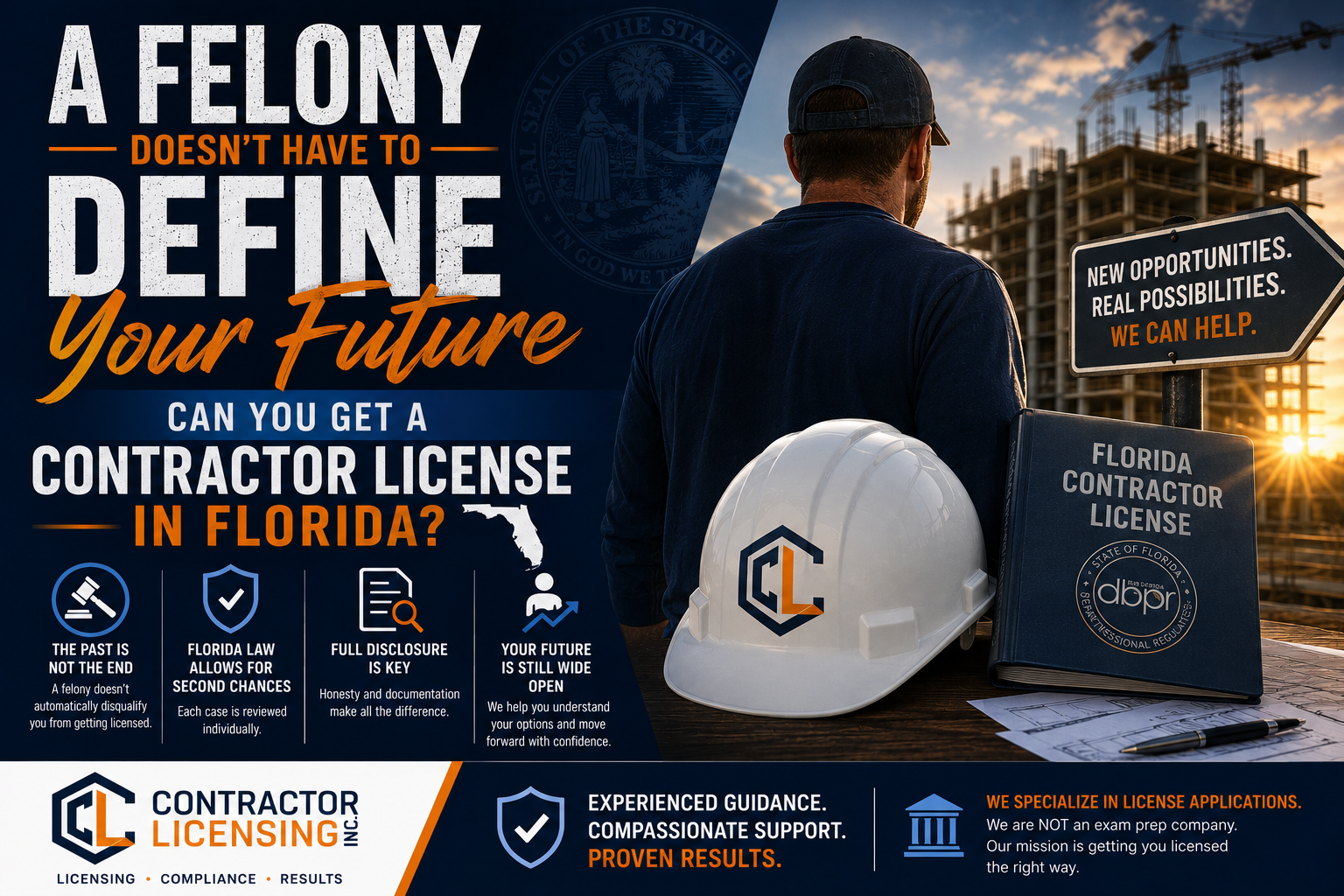
A Felony Doesn’t Have to Define Your Future: Can You Get a Contractor License in Florida?
The short answer is yes — a felony conviction does not automatically disqualify you from getting a Florida contractor license. But the longer answer matters, because the path forward depends on the nature of your conviction, how much time has passed, and how you present your application to the Construction Industry Licensing Board.
This isn’t a loophole or a technicality. It’s what Florida law actually says. Understanding the rules clearly — and preparing your application accordingly — is the difference between a license and a denial.
What Florida Law Actually Says
Florida’s contractor licensing statutes are notably different from other professional licensing areas. While some professions in Florida — private investigators, insurance agents, motor vehicle dealers — have explicit bars against felony convictions, construction contracting does not.
Florida Statute §489.111 governs contractor license qualifications. The standard it sets is “good moral character” — not a clean criminal record. The statute is explicit on this point: the CILB may not deny licensure based solely on a felony conviction, and it may not deny licensure solely because an applicant has not had civil rights restored.
Florida appellate courts have confirmed this interpretation. In multiple cases, courts have held that Chapter 489 contains no automatic, categorical disqualifications for prior felony convictions. The question is always one of good moral character and whether there is a substantial connection between the conviction and the professional responsibilities of a contractor.
That’s meaningful legal protection — and it means that for many people with a criminal record, a Florida contractor license is a realistic goal.
The Two-Part Test the CILB Uses
Under §489.111(3)(a), the CILB can only refuse to certify an applicant for lack of good moral character if both of the following conditions are met:
1. There is a substantial connection between the lack of good moral character and the professional responsibilities of a certified contractor.
2. The finding of lack of good moral character is supported by clear and convincing evidence.
Both prongs must be satisfied. A conviction that has no meaningful relationship to contracting — fraud against consumers, financial crimes involving clients, theft from job sites — carries more weight than a conviction with no connection to construction. A conviction for a drug offense from 15 years ago, with no subsequent criminal history, is a very different situation than a recent conviction for contractor fraud.
When the CILB denies an application on character grounds, it must provide the applicant with written findings, a complete record of the evidence, and notice of the right to a rehearing or appeal. The board cannot simply reject an application without articulating a specific, evidence-based reason.
What the CILB Considers at the Board Hearing
Applicants with a criminal history will almost always have their application reviewed at a full CILB board hearing rather than being approved administratively. This is not a denial — it’s a review process. The hearing is your opportunity to present your case.
The CILB evaluates several factors when reviewing an application with criminal history:
Nature and severity of the offense. The type of crime matters significantly. Offenses involving financial fraud, theft, consumer deception, or crimes directly related to construction and contracting carry the most weight. Crimes involving violence are evaluated for public safety implications. Crimes with no connection to the construction industry are considered in a different light.
Relationship to contracting. The closer the connection between the offense and the work of a licensed contractor — trust, financial responsibility, supervision of workers, dealings with property owners — the more seriously the CILB will weigh it. A fraud conviction is more concerning to a board evaluating a contractor applicant than many other types of offenses.
Time elapsed since the conviction. This is one of the most important factors. Florida’s CILB is required to consider the passage of time between a disqualifying offense and the date of application. The longer the period without any subsequent criminal activity, the stronger the case for approval. A conviction from 20 years ago with a clean record since carries very different weight than a conviction from two years ago.
Rehabilitation efforts. The board looks favorably on applicants who can demonstrate genuine rehabilitation: completion of substance abuse treatment, counseling, vocational training, community service, or any other structured effort to address the underlying circumstances of the offense. Letters from employers, mentors, clergy, or community organizations that speak to your character and conduct since the conviction are valuable evidence.
Pattern of conduct. A single conviction in an otherwise clean history is evaluated differently from multiple convictions, an ongoing pattern of offenses, or convictions that occurred after a prior licensing matter. The CILB looks at the whole picture, not just the most recent charge.
Civil rights restoration. While restoration of civil rights is not required for a contractor license in Florida, having your rights restored demonstrates a formal legal recognition of rehabilitation and can strengthen an application.
Offenses That Carry the Greatest Weight
While there is no absolute bar against felons getting a contractor license in Florida, certain offense types are more likely to create serious obstacles:
Crimes directly related to contracting are the most problematic. Contractor fraud, misapplication of construction funds, unlicensed contracting for financial gain, and similar offenses go to the heart of what the CILB is trying to protect against. If your conviction involved deceiving property owners, misusing client funds, or operating dishonestly as a contractor, the board will scrutinize your application intensely.
Sex offenses, particularly involving minors, are treated as serious character issues regardless of how much time has passed. These fall in a separate category from most other offenses.
Recent convictions — particularly those within the last two years — are harder to overcome. Florida law has moved toward a framework where older convictions carry less weight, but recent criminal history is treated as more directly relevant to present character.
Multiple convictions across different offense types signal a pattern the board will take seriously, even if individual offenses are minor.
Offenses That Are More Manageable
Many applicants with criminal records obtain Florida contractor licenses successfully. Offense types that tend to be more manageable include:
- Non-violent drug offenses, particularly when significant time has passed and rehabilitation is documented
- Alcohol-related offenses from many years ago with no subsequent issues
- Offenses with no connection to construction, financial trust, or consumer dealings
- Single convictions with long clean records since
The key in all of these situations is presentation: how you disclose the conviction, what supporting documentation you provide, and whether your application demonstrates that the offense is genuinely in the past.
The Disclosure Requirement: Don’t Hide It
Every Florida contractor license application requires full disclosure of criminal history. This is not optional, and the temptation to minimize or omit a conviction is one of the most damaging mistakes an applicant can make.
Failing to disclose a conviction — or misrepresenting your criminal history — is treated far more seriously than the underlying offense itself. The CILB views concealment as direct evidence of the kind of dishonesty that is incompatible with a contractor’s professional responsibilities. An applicant who fully discloses a 10-year-old conviction and presents evidence of rehabilitation stands a much better chance than an applicant who tries to hide a minor offense and gets caught.
Disclose everything. Then present it well.
How to Build the Strongest Possible Application
If you have a criminal record and want to apply for a Florida contractor license, preparation matters enormously. The goal is to give the CILB a complete picture that addresses the conviction directly and demonstrates that you are the kind of person who can be trusted with a contractor license.
Write a personal statement. A clear, honest written explanation of the circumstances of your conviction, what you’ve done since, and why you are prepared to serve property owners responsibly is one of the most powerful parts of an application with criminal history. Don’t minimize the offense — own it and explain your growth.
Gather character references. Letters from employers, contractors, supervisors, community leaders, or others who know your character and work ethic speak directly to the CILB’s core question. Letters from people who knew you both before and after the conviction carry particular weight.
Document your rehabilitation. If you completed any treatment programs, counseling, vocational training, or community service, gather certificates or letters of completion. If you have construction-related work history from the period since your conviction, document it thoroughly — it demonstrates that you’ve been building a legitimate career.
Demonstrate financial responsibility. The CILB also evaluates financial responsibility as part of the application. If your conviction involved any financial restitution orders, show that they’ve been satisfied or are being actively addressed.
Get your civil rights restored if you haven’t already. While not required, restoration of civil rights strengthens your application and reflects well on the board review process. Applications can be submitted to the Florida Office of Executive Clemency after supervision ends.
Consider professional application assistance. Applications with criminal history are among the most complex CILB submissions. An experienced licensing service that has navigated board hearings with criminal background components understands how to frame your documentation, anticipate the board’s questions, and present your application in the strongest possible light.
Construction Is One of the Best Industries for a Second Chance
The construction industry has long been more accessible to people with criminal records than most other licensed professions — and Florida’s legal framework reflects that reality. The skills required to succeed as a contractor are developed through hands-on work, not academic credentials. The law recognizes that a person can build genuine competency and trustworthiness over time, regardless of what they did in the past.
Across Florida, licensed contractors with prior convictions are running successful businesses, employing workers, and building their communities. The path isn’t easy, and it requires careful preparation — but it is very much open.
Frequently Asked Questions
Can a felon get a contractors license in Florida? Yes. Florida Statute §489.111 does not categorically bar felons from obtaining a contractor license. The CILB evaluates applications with criminal history based on good moral character, the nature of the offense, its connection to contracting, the time elapsed, and evidence of rehabilitation. The board cannot deny an application based solely on a felony conviction.
What crimes will prevent me from getting a contractor license in Florida? There is no fixed list of automatically disqualifying offenses for contractor licensing in Florida. Offenses most likely to result in denial include crimes directly related to contracting (fraud, misappropriation of construction funds, consumer deception), recent convictions, patterns of multiple offenses, and sex crimes particularly involving minors. Each application is evaluated individually.
Do I need to have my civil rights restored to apply? No. Florida law explicitly states that the CILB may not deny a contractor license application based solely on the applicant’s failure to provide proof of restoration of civil rights. However, having rights restored can strengthen your application and is worth pursuing if you haven’t already done so.
Will my criminal history automatically go to a board hearing? Almost certainly yes. Applications with disclosed criminal history are typically routed to the full CILB for review rather than processed administratively. This is a review process, not a denial — it’s your opportunity to present your case and documentation directly to the board.
What if my application is denied? If the CILB denies your application, it must provide written findings and notice of your right to a rehearing or appeal. You can challenge the denial through Florida’s administrative appeals process. Working with a Florida construction law attorney or experienced licensing service on the appeal significantly improves your chances of a successful outcome.
Can I get a contractor license with a misdemeanor in Florida? Most misdemeanor convictions are reviewed and approved by the DBPR and CILB, particularly when time has passed and the offense is unrelated to contracting. Misdemeanors go through the same character review process but are generally treated as less serious than felony convictions. Full disclosure and supporting documentation still matter.
Your Record Doesn’t Have to Be the End of the Story
Florida’s contractor licensing system is built on the principle that what matters most is who you are today — not just what’s on paper from years ago. The CILB evaluates character, not just history. And character is something that can be demonstrated, documented, and presented.
If you have a criminal record and are serious about getting licensed, the most important thing you can do is approach the process with preparation, transparency, and the right support.
Contractor Licensing Inc. has helped applicants with complex backgrounds navigate the CILB process — including board hearings, character documentation, and the specific framing that gives applications the best possible chance of approval. We know what the board looks for and how to present your story in the strongest possible light.
Visit contractorlicensinginc.com or call our Florida office during business hours to talk through your situation confidentially.
This article is for informational purposes only and does not constitute legal advice. Florida CILB requirements and board review criteria are subject to change. For guidance specific to your criminal history and license application, consult a qualified Florida construction law attorney or licensing specialist.