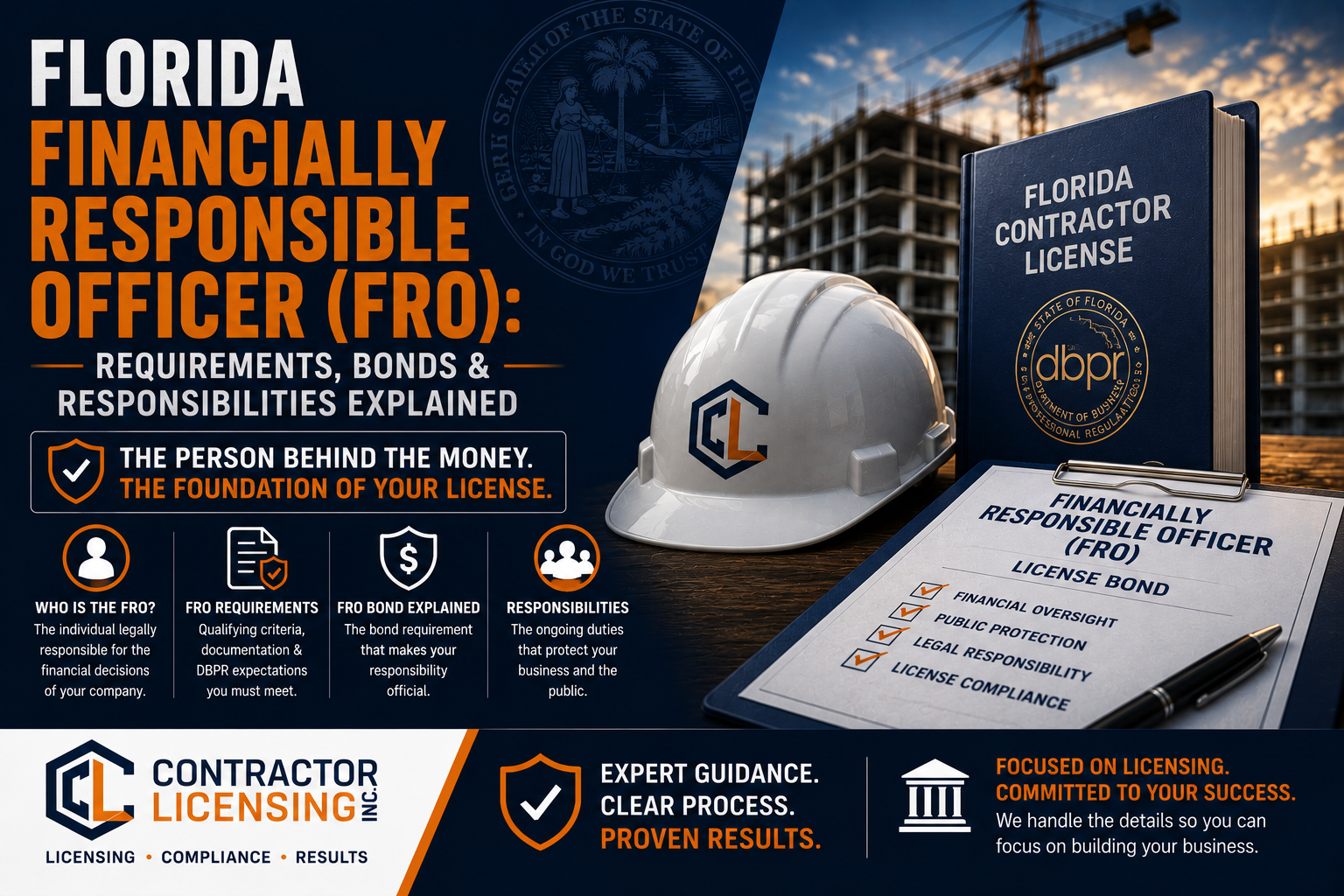
Florida Financially Responsible Officer (FRO): Requirements, Bonds & Responsibilities Explained
If you’re using an outside qualifying agent to license your Florida construction business, there’s a role you may not have heard of — and a bond you absolutely cannot skip. The Financially Responsible Officer, or FRO, is one of the most misunderstood parts of the Florida contractor licensing structure. Get it wrong and your license won’t be valid. Get it right and it protects everyone — including you.
This guide explains exactly what an FRO is, when you need one, what the bond covers, and how to get it done quickly.
What Is a Financially Responsible Officer?
A Financially Responsible Officer (FRO) is the person who takes personal responsibility for all financial aspects of a licensed Florida construction business. The role is defined under Florida Statute §489.1195 and is administered by the Construction Industry Licensing Board (CILB).
Here’s the simplest way to understand why the FRO exists:
Every Florida contractor license requires two things working in tandem — someone who is responsible for the construction operations and someone who is responsible for the financial operations. When those two roles are held by the same person (the owner-qualifier), no FRO is needed. But when they’re split — when an outside qualifying agent holds the license, and a company owner or executive is running the business financially — the CILB requires the financial side to be formally designated, approved, and bonded.
That designation is the FRO.
Under the statute, the FRO:
- Is personally responsible for all financial matters of the business, including contracts, payments, reporting, and compliance with financial provisions of Florida law
- Cannot also be designated as the primary qualifying agent — the two roles must be held by separate individuals
- Must demonstrate financial responsibility, creditworthiness, and a sound business reputation to the CILB’s satisfaction
- Is subject to CILB disciplinary proceedings in the event of consumer financial harm
In practice, the FRO is typically the majority owner, a principal officer, or the person who actually controls the money in the business. The CILB formalizes that reality through the designation process.
When Does a Business Need an FRO?
Not every Florida contractor license requires an FRO. Here’s how to know if yours does:
You do NOT need an FRO if the qualifying agent is also a significant owner of the business — typically an owner with meaningful financial control and an ownership stake in the company. In that case, the qualifier is already responsible for both construction operations and financial matters, and no separate FRO designation is needed.
You DO need an FRO if the qualifying agent is an outside contractor who holds the license but does not have ownership or financial control in the business. This is a common arrangement — many construction businesses use a qualifier placement service (like Contractor Licensing Inc.) to bring in a licensed contractor as the qualifying agent while the business owner runs day-to-day operations. In that structure, the CILB requires the business to designate a financially responsible officer from within the company.
Other situations that commonly trigger FRO requirements:
- A company is purchased and the new owner is not the qualifying agent
- A qualifier arrangement is restructured and the qualifier no longer holds ownership
- A business expands and a second qualifying agent is brought in without ownership interest
- A holding company structure separates the ownership of the license from the financial control of the business
When in doubt, the CILB’s standard question is simple: does the qualifier have meaningful financial control over the business? If the answer is no, an FRO is likely required.
The FRO Bond: Why It’s Mandatory — Not Optional
Here is the part that trips up businesses most often: the FRO designation is not complete until the bond is in place. The CILB will not approve the FRO application without it, and the license is not valid without an approved FRO when one is required.
This is not a technicality. It’s a hard requirement under Rule 61G4-15.0021, Florida Administrative Code. The bond must be filed with the CILB, and the FRO’s designation does not become active until the bond is confirmed.
What Is the FRO Bond?
The FRO bond is a $100,000 surety bond issued in favor of the Florida Construction Industry Licensing Board. It guarantees that the FRO will fulfill their legal and financial obligations to the state, to consumers, and to the CILB — including payment of any fines, costs, or penalties levied against the business for licensing violations.
For contractors who held a registered license prior to February 1, 2007, the bond amount is $50,000. For everyone else, it’s $100,000.
The bond is not insurance. It is a financial guarantee. Here’s the critical distinction: if a claim is paid on the bond, the surety company that issued it has the right to seek full reimbursement from the FRO personally. The bond protects the public and the CILB — not the FRO.
What the Bond Covers
The FRO bond exists to ensure:
- Financial records are properly maintained in accordance with Florida law
- Required reports are filed accurately and on time
- All funds, fees, and payments required by the state are made
- Business operations comply with DBPR and CILB rules
- The public has a financial backstop if the business causes harm through financial misconduct
If the CILB levies fines or costs against the business and they go unpaid, the bond can be called upon. If a consumer suffers financial harm due to the FRO’s failure to meet their statutory obligations, the bond provides a recovery mechanism.
How Long Must the Bond Remain in Force?
The FRO bond must remain active for as long as the FRO designation is in place — which means for the life of the contractor license, until the license expires, or until the FRO is changed. The surety company may cancel the bond with 30 days’ written notice to the CILB, but remains liable for obligations that arose before cancellation. When the bond is cancelled, the FRO designation effectively ends — and so does the license’s validity if a new FRO is not designated and bonded.
Renewal notices are typically sent 90 days before the bond’s annual renewal date. Missing the renewal is a compliance failure that can put your license at risk.
How to Apply for the FRO Designation
The FRO applies separately from the qualifying agent using DBPR Form CILB 8 — Application for Financially Responsible Officer. The application fee is $200 (flat, not date-dependent).
Along with the completed form, the FRO applicant must submit:
- Electronic fingerprints through an FDLE-approved Livescan provider
- Personal credit report with a FICO-derived score and public records statement
- Proof of satisfaction of any liens, judgments, or discharged bankruptcies (if applicable)
- Criminal history disclosure with full explanation of any convictions
- The executed FRO bond — $100,000 from an approved surety company
The CILB reviews the FRO application and, upon approval, officially designates the individual as the financially responsible officer on the license record. Processing typically takes 4 to 8 weeks from a complete submission.
Two important reminders:
- The FRO and qualifying agent applications are separate submissions. If you are setting up a new qualifying agent arrangement with an FRO at the same time, both forms go to the DBPR — the qualifier on their applicable CILB 5 or 6 form, and the FRO on CILB 8.
- When a licensed contractor is qualifying an additional business entity (CILB Form 9) and that entity needs an FRO, the FRO completes CILB 8 for that specific business. The FRO designation is per-business, not per-license.
What Happens If You Skip the FRO or Let the Bond Lapse?
The consequences are direct and serious:
Without an approved FRO when one is required, the CILB will not issue or maintain a valid license for the business. The license may be placed on inactive status or flagged as non-compliant.
If the FRO bond lapses, the FRO designation becomes invalid. A license that requires an FRO and no longer has one with an active bond is in violation of Florida law — which exposes the business to unlicensed activity consequences under Chapter 489.
If the FRO changes, a new CILB 8 application must be submitted and a new bond must be issued for the incoming FRO before the change is effective. You cannot simply substitute one FRO for another without going through the full application and bonding process again.
None of this is complicated to manage when you stay ahead of it. The problem arises when businesses let renewals slip, fail to file a new FRO application after a personnel change, or assume the bond renews automatically without monitoring it.
Get Your FRO Bond Through Artisan Insurance Inc.
The FRO bond is available through licensed surety providers, and the cost is determined by the FRO’s personal credit profile. For well-qualified applicants, the annual premium is typically a small fraction of the $100,000 bond amount.
Contractor Licensing Inc. works directly with Artisan Insurance Inc. for FRO bond placement. Lindsey at Artisan Insurance Inc. specializes in contractor surety bonds and can issue your FRO bond quickly — keeping your application timeline on track.
FRO bonds through Artisan Insurance Inc. are available starting at $1,000.
To get your bond started, email Lindsey directly:
lindsey@artisaninsuranceinc.com
Include your name, the name of the business being qualified, and a brief note that you need an FRO bond for a Florida CILB application. Lindsey will take it from there.
Important: The FRO bond must be in hand and submitted with your CILB 8 application. The CILB will not process or approve the FRO designation without it. Do not submit the FRO application without the bond already issued and ready to attach.
Frequently Asked Questions
Does every Florida contractor license require an FRO? No. An FRO is required only when the qualifying agent does not have financial control of the business — typically when the qualifier is an outside contractor who does not own or financially control the company. If the qualifier is also the majority owner who controls the business finances, no FRO is needed.
Can the qualifying agent and the FRO be the same person? No. Florida Statute §489.1195 explicitly states that the financially responsible officer may not be designated as the primary qualifying agent. The two roles must be held by different individuals.
What credit score does the FRO need? The CILB evaluates the FRO’s financial standing as part of the approval process, similar to how it evaluates qualifying agent applicants. Good credit strengthens the application. Poor credit, outstanding judgments, or unresolved tax liens can complicate or delay approval and will affect the cost of the bond.
What is the FRO bond amount in Florida? The standard FRO bond is $100,000 payable to the Florida Construction Industry Licensing Board. Contractors who held a registered license prior to February 1, 2007 may qualify for a reduced $50,000 bond amount.
How long does it take to get the FRO designation approved? Processing typically takes 4 to 8 weeks from the date a complete application is submitted. Having the bond in hand before you submit — rather than trying to obtain it after — is the single most important thing you can do to keep the timeline moving.
What happens when the FRO leaves the company? The business must designate a new FRO through a fresh CILB 8 application and obtain a new bond. Until the new FRO is approved by the board and the bond is in place, the prior FRO’s departure creates a compliance gap. Address personnel changes proactively — don’t wait for the license to lapse.
Need Help Setting Up Your FRO?
If your qualifying arrangement requires an FRO, getting it right from the start saves time and prevents compliance issues down the road. That means the right CILB form, the right bond, and the right documentation submitted together as a complete package.
Contractor Licensing Inc. handles FRO applications alongside qualifying agent setups — coordinating the paperwork, timing the submissions, and connecting you directly with Artisan Insurance for the bond.
Visit contractorlicensinginc.com or call our Florida office during business hours to get started.
For your FRO bond, contact Lindsey at Artisan Insurance Inc. directly: lindsey@artisaninsuranceinc.com
This article is for informational purposes only and does not constitute legal advice. Florida CILB requirements are subject to change. Always verify current FRO and bonding requirements directly with the DBPR at myfloridalicense.com or by calling 850-487-1395.