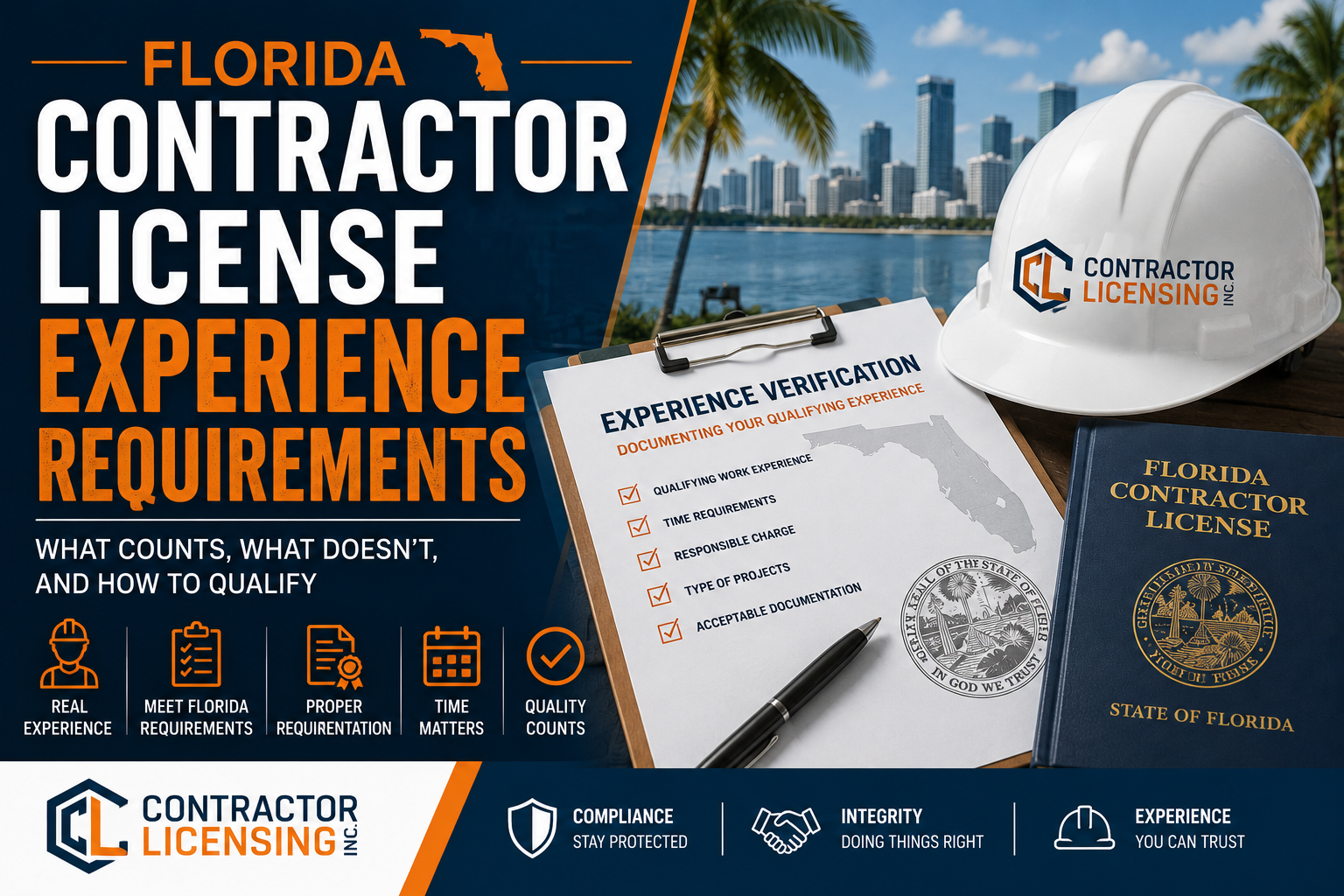
Florida Contractor License Experience Requirements: What You Need to Qualify
Passing the exam is only half the battle. Before the Florida Construction Industry Licensing Board will issue your contractor license, you have to prove you’ve actually done the work — and that proof has to be documented in a very specific way.
Experience verification is the single most common reason Florida contractor license applications get delayed or sent back with a deficiency letter. Not because applicants lack the experience, but because they don’t document it the way the CILB expects. This guide breaks down exactly what Florida requires, what counts, what doesn’t, and how to put together a package that moves through review without problems.
The Baseline: What Florida Requires
Florida Statute Chapter 489 and the CILB’s administrative rules require every applicant for a certified contractor license to meet an experience threshold before the license will issue. For Division I licenses — General Contractor (CGC), Building Contractor (CBC), and Residential Contractor (CRC) — the standard requirement is:
- 4 years of verifiable construction experience within the last 10 years
- At least 1 of those years must be supervisory — meaning foreman, superintendent, or project manager with documented authority over crews, scheduling, and job site decisions
- Experience must be relevant to the license classification you’re applying for
One year of experience equals a minimum of 2,000 hours of qualifying work. The CILB counts years, not just titles — what matters is the scope and nature of the work you performed, not what your business card said.
The Six Qualification Pathways
Florida doesn’t have a single rigid path to meeting the experience requirement. The CILB recognizes six combinations of field experience and education. Most contractors qualify under one of the following:
Pathway 1 — Four-Year Degree + One Year Field Experience A bachelor’s degree in construction management, civil engineering, architecture, or building construction from an accredited college counts as three years of experience. Combined with one year of proven field experience, this satisfies the four-year requirement. The one field year does not need to be supervisory under this pathway, but your role must still be documented in detail.
Pathway 2 — Three Years College Credits + One Year as Foreman At least three years of accredited college-level coursework in a construction-related field, combined with one year of documented foreman-level experience. The foreman year is mandatory under this combination.
Pathway 3 — One Year Worker + One Year Foreman + Two Years College A blend of one year as a tradesperson, one year in a supervisory role, and two years of accredited construction-related coursework.
Pathway 4 — Two Years Worker + One Year Foreman + One Year College Two years of field experience as a skilled worker, one year as a foreman, and one year of qualifying college credits.
Pathway 5 — Four Years Field Experience, At Least One as Foreman The most common pathway. Four years of hands-on construction experience within the last ten years, with at least one year in a supervisory capacity. No education required.
Pathway 6 — The Upgrade Method A licensed Certified Residential Contractor (CRC) or Certified Building Contractor (CBC) who has held an active license in good standing for at least four years — with no disciplinary citations — can upgrade to a Certified General Contractor license without submitting a full employment history. Your existing license number is submitted for verification instead.
What “Supervisory Experience” Actually Means
This is where many applicants run into trouble. The CILB does not accept a job title alone as proof of supervisory experience. Claiming you were a “foreman” without documentation of what that role actually involved will generate a deficiency.
Supervisory experience, as the CILB defines it, means you exercised direct authority over:
- Managing and directing a crew of workers
- Making project scheduling decisions
- Coordinating subcontractors or trade work
- Quality control and code compliance on the job site
- Decision-making authority over project scope or materials
General labor, material delivery, task execution under someone else’s direction, or administrative support work does not meet the supervisory threshold — regardless of what the job title was. The CILB looks at what you actually did, not what you were called.
CGC-Specific Experience: The Additional Layer
If you’re applying for a Certified General Contractor (CGC) license specifically, there’s an added requirement on top of the standard four-year threshold:
Your experience must cover at least 4 of the 6 CILB construction categories, and at least a portion of your experience must involve new vertical construction — meaning the construction of habitable structures, not just site work, renovation, or demolition. For applicants whose experience involves multi-story construction, at least one year should include structures of four stories or taller.
This is why experience documentation for a CGC application needs to be more detailed than for a CBC or CRC. The board is specifically looking for breadth across construction types, not just depth in one area.
Military Experience
Florida gives veterans meaningful credit toward the experience requirement. Active military construction experience substitutes year-for-year toward the four-year requirement — and unlike civilian experience, military service does not have to be in a construction-specific role in all cases.
Veterans applying under this provision must submit a DD-214 as part of their application package. If you served in a construction-related MOS or rate, document it specifically in your employment history. The more clearly you can connect your military duties to the CILB’s construction categories, the stronger your application.
How to Document Your Experience: The CILB 4359 Form
Here’s where more applications fall apart than anywhere else.
Florida uses Form DBPR CILB 4359 — Verification of Construction Experience as the primary mechanism for documenting field experience. Understanding how this form works — and how it doesn’t — is critical:
The form must be completed and signed by your supervising contractor, not by you. This is a hard rule. The CILB specifically looks for and rejects any Form CILB 4359 that appears to have been completed by the applicant. The supervising contractor must sign the form in ink, and in many cases the form must be notarized. Submitting a form you filled out yourself — even if you then handed it to a supervisor to sign — is grounds for rejection.
Each supervisor requires a separate form. If you worked under multiple licensed contractors during your four years, you need a separate CILB 4359 from each one. One form covering your entire employment history from multiple employers will not be accepted.
Project-level detail is required. The form asks for specific information about each project you worked on: type of construction, number of stories, square footage, materials used, your specific role and responsibilities, and the dates of your involvement. Vague descriptions like “general construction work” or “helped with various projects” will generate a deficiency. The board wants to see that your experience is concrete and verifiable.
DBPR contacts your supervisors directly. This is not a formality. DBPR staff will call the contractors listed on your CILB 4359 forms to verify the information you submitted. Make sure your supervisors are aware their contact information will be used and are prepared to confirm what’s in the form.
Supporting Documentation
In addition to the CILB 4359 forms, your experience package should include:
- W-2 statements or pay stubs for each year of experience listed — these establish that you were actually employed during the claimed period
- Schedule C or K-1 forms if you were self-employed during any qualifying period
- Construction-related college transcripts if you’re using education to substitute for experience years
- DD-214 for military experience claims
- A chronological employment history that accounts for the entire qualifying period with no unexplained gaps exceeding 30 days
The CILB cross-references all of these documents against each other. If your W-2 shows employment with Company A from 2020 to 2022, but your CILB 4359 shows a different employer during that period, the inconsistency will generate a deficiency — or worse, trigger additional scrutiny of your entire application.
Self-Employed Applicants
If you’ve been operating your own construction business without a license and want to document that work as qualifying experience, the process is more involved but workable.
Because you can’t submit a CILB 4359 signed by a licensed contractor who supervised your own business, the CILB accepts alternative documentation including:
- Schedule C tax records showing construction income
- Signed client affidavits describing the scope of work you performed
- Building permits pulled under a licensed qualifying agent on your projects
- Photos, contracts, and project records showing the nature and scale of your work
The CILB will scrutinize self-employment experience more carefully than employment under a licensed contractor. Make sure your documentation is thorough, specific, and consistent with the construction categories the board is looking for.
The 10-Year Window
All experience must fall within the 10 years immediately preceding the date of your application. Experience older than 10 years does not count, regardless of how relevant it is. If you took a long break from construction and are returning to the trade, you may need to accumulate additional recent experience before applying — or explore the education substitution pathways if you hold a relevant degree.
Legal and Compliance Considerations
Submitting inaccurate experience documentation is fraud. The CILB takes misrepresentation seriously. Submitting falsified W-2s, coaching a supervisor to sign a form that overstates your role, or manufacturing project records to fill gaps in your history are all grounds for denial — and can result in a permanent bar from Florida licensure and potential criminal charges. The board does verify, and they do catch discrepancies.
A deficiency on experience is not the end. If your application comes back with an experience-related deficiency, you have a window to respond with corrected or additional documentation. Work quickly, be specific in your response, and address exactly what the board flagged — not just the general topic.
2025 licensing changes affect registered contractors. Under House Bill 735, effective July 1, 2025, the local registered contractor pathway has been eliminated for most license types. Contractors who previously held local registered licenses must now obtain a state Certified license through DBPR. The experience requirements are the same — but the process now goes through CILB, not your local building department. Registered contractors with five or more years of active licensure and no citations may qualify for the upgrade method.
Frequently Asked Questions
Can I use experience from another state toward a Florida contractor license? Yes. Out-of-state experience counts toward Florida’s four-year requirement as long as it falls within the 10-year window and can be verified through CILB 4359 forms signed by the supervising contractors. The nature of the work — not where it was performed — is what matters to the CILB.
What if my former employer is no longer in business? This is a common challenge and the CILB has addressed it. If a former employer is unreachable or out of business, you can submit alternative documentation: tax records, project records, permits, client affidavits, and a written explanation of why the standard CILB 4359 couldn’t be obtained. The board reviews these situations on a case-by-case basis.
Does experience as a subcontractor qualify? It can. If you operated as a subcontractor under a licensed general contractor and can document that relationship — with the GC signing your CILB 4359, supported by tax records and project detail — that experience is generally qualifying. The key is that the supervision chain must lead to a licensed contractor who can verify your work.
How specific do project descriptions need to be? Very specific. The CILB 4359 asks for project type, stories, square footage, materials, and your specific role on each project. “Commercial construction work” is not sufficient. “Foreman on a 3-story, 28,000 sq ft tilt-wall warehouse; managed a crew of 8, coordinated concrete and steel subcontractors, responsible for schedule and quality compliance” is the level of detail the board is looking for.
Can I use the same experience for both my exam qualification and my license application? Yes. Florida does not require you to have separate experience for exam eligibility and license application. The same four-year experience period supports both.
Get Your Experience Documentation Right the First Time
Experience verification is the part of the Florida contractor license application that catches the most people off guard — not because the requirement is unreasonable, but because the documentation standards are specific and unforgiving. A missing form, a vague project description, or an employment gap of more than 30 days can send your application back and add months to your timeline.
Contractor Licensing Inc. helps contractors put together complete, board-ready experience packages from the start. We know exactly what the CILB is looking for, how to document non-standard experience situations, and how to respond when a deficiency letter arrives.
Visit contractorlicensinginc.com or call our Florida office during business hours. Get it right the first time and get licensed faster.
This article is for informational purposes only and does not constitute legal advice. Florida CILB requirements are subject to change. Always verify current standards with the Florida DBPR or a qualified contractor licensing specialist before submitting your application.

Leave a Reply
Your email is safe with us.