# Contractor Licensing Deficiency Letters Explained
You submitted your contractor license application. You waited. And instead of an approval, you got a letter telling you something is missing or wrong.
That’s a deficiency letter — and if you’ve never seen one before, it can feel like a setback. It doesn’t have to be. Understanding what a deficiency letter means, why it was issued, and exactly how to respond is the difference between a delayed license and a denied one.
This guide walks you through everything contractors need to know about licensing deficiency letters, from common triggers to state-specific considerations to what happens if you ignore one.
—
## What Is a Contractor Licensing Deficiency Letter?
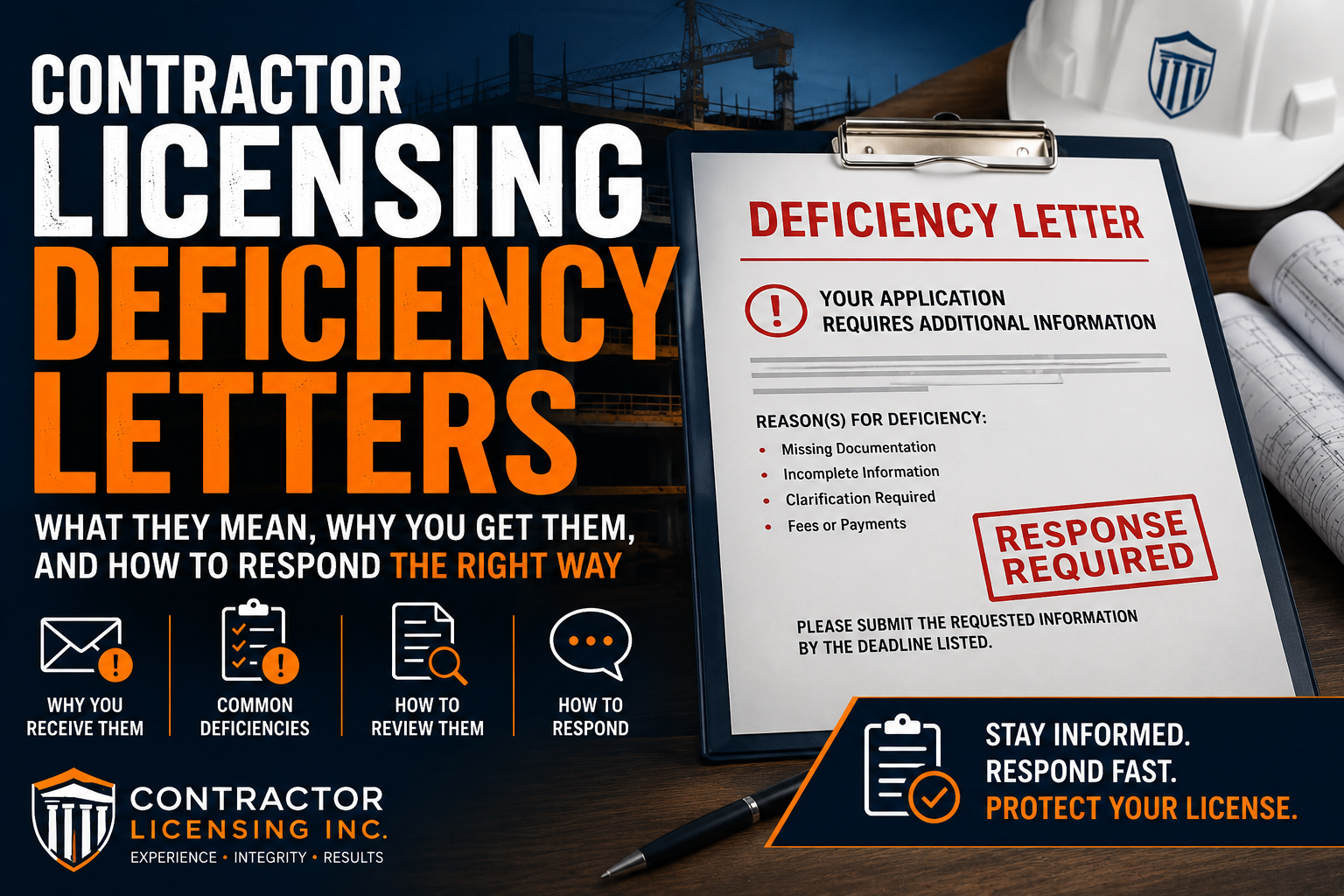
A **contractor licensing deficiency letter** (sometimes called a deficiency notice or incomplete application notice) is a formal communication from a state contractor licensing board informing an applicant that their submission is incomplete or does not meet the board’s requirements.
It is not a denial. It’s the board telling you: *something is missing or needs to be corrected before we can move forward.*
Deficiency letters are issued at the administrative review stage — before your application reaches a board examiner or hearing officer. That means the clock is ticking on your window to respond, but you still have a clear path to approval if you act correctly and promptly.
—
## Why Do Contractors Receive Deficiency Letters?
Licensing boards review dozens — sometimes hundreds — of applications at any given time. Any gap, inconsistency, or missing document triggers a deficiency notice. The most common reasons include:
**Missing or incomplete documentation**
The most frequent cause. An application that references an insurance certificate, financial statement, or experience verification that wasn’t actually included will generate an immediate deficiency.
**Insurance or bonding issues**
Your certificate of insurance may have been submitted but shows incorrect coverage limits, lists the wrong entity name, or has already expired. Some states require you to be listed as the certificate holder in a specific way — small formatting issues can trigger deficiencies.
**Experience verification gaps**
Most states require proof of qualifying work experience — typically four or more years in the relevant trade. If your experience letters are vague, cover the wrong time periods, are signed by someone without verifiable authority, or don’t align with the dates on your application, you’ll receive a deficiency.
**Financial responsibility problems**
Many boards review personal and business credit as part of the application. A credit score below the state’s threshold, unresolved judgments, tax liens, or an incomplete financial statement can all generate a deficiency or a more serious administrative hold.
**Exam score issues**
If the exam score on file doesn’t match the license classification you’re applying for, or if a score has expired under that state’s rules, the board will flag it.
**Entity or business formation problems**
If your business entity isn’t registered with the state, your registered agent information is outdated, or your entity type doesn’t match what the board requires for your license classification, you’ll hear about it.
**Background check or fingerprint issues**
Some states require fingerprinting through specific vendors or within specific timeframes. A missing fingerprint submission or a background check that hasn’t cleared yet is a common deficiency trigger.
—
## How to Read a Deficiency Letter
Deficiency letters vary in format by state, but most share a common structure:
1. **Identification of the application** — your name, entity name, license classification, and application number
2. **List of deficiencies** — specific items that are missing, incorrect, or incomplete
3. **Required corrective actions** — what you need to submit or fix for each deficiency
4. **Response deadline** — the date by which you must respond, or the application may be closed
5. **Submission instructions** — how and where to send the corrected information
Read every line carefully. Boards are specific in their deficiency language, and submitting a document that addresses the general topic but not the exact deficiency will often result in a second deficiency letter — extending your timeline further.
—
## Response Deadlines: Don’t Miss Them
This is where many contractors lose ground they didn’t need to lose.
Most state licensing boards give applicants a **30 to 60 day window** to respond to a deficiency letter. Some states are more generous; others are not. If you miss the deadline:
– Your application may be **administratively closed**, requiring you to start over with a new application and new fees
– In some states, a closed application can create a waiting period before you can reapply
– Any exam scores associated with the application may need to be resubmitted or re-verified
If you need more time — because you’re gathering financial documents, waiting on a credit repair outcome, or coordinating with a former employer for experience verification — **contact the board before the deadline expires** and ask for an extension. Many boards will grant a reasonable extension when asked proactively. They will rarely grant one after the deadline has passed.
—
## State-Specific Considerations
While the deficiency process is broadly similar across states, the specifics vary enough that it matters where you’re applying.
**Florida**
The Florida DBPR and Construction Industry Licensing Board (CILB) issue deficiency notices through their online portal. Florida applications that don’t meet financial responsibility standards — including credit score thresholds — are often placed on hold pending additional documentation or a Financially Responsible Officer (FRO) designation. Response windows are strictly enforced.
**Georgia**
Georgia’s State Licensing Board for Residential and General Contractors commonly issues deficiencies related to experience verification. Georgia requires experience letters that specifically describe the applicant’s role, the type of work performed, and the duration — generic reference letters are routinely flagged.
**Tennessee**
The Tennessee Contractors Board frequently cites deficiencies around business entity registration and proof of workers’ compensation coverage. Tennessee also requires specific documentation for the tier of license being applied for, and submitting documents scaled to the wrong tier is a common error.
**North Carolina**
The NC Licensing Board for General Contractors is thorough in its financial review. Deficiencies related to financial statements — including balance sheet formatting, incomplete notes, or the use of compiled rather than reviewed financials — are common. NC also requires exam scores in specific classifications, and score/classification mismatches generate consistent deficiencies.
**South Carolina**
South Carolina’s Contractor’s Licensing Board frequently issues deficiencies related to insurance certificates and entity registration. SC requires that the licensed entity and the insured entity match exactly — name variations between your application and COI are a reliable deficiency trigger.
**Alabama and Mississippi**
Both states commonly issue deficiencies related to experience documentation, particularly for applicants who are newer to the commercial contracting space. Clear, detailed experience affidavits from verifiable supervisors are essential in both states.
—
## Legal and Compliance Considerations
A deficiency letter is an administrative matter, not a disciplinary one — but how you respond can have real legal and practical consequences.
**Don’t ignore it.** An unresponded deficiency letter results in a closed application. In some jurisdictions, it can be treated as a withdrawal, which may affect your eligibility to reapply under certain timelines or create a record that shows up in future licensing background checks.
**Don’t submit documents you can’t verify.** If a board asks for experience verification and you submit letters from former employers without their knowledge or with inaccurate information, you’re creating a fraud exposure. Boards cross-reference, call references, and flag inconsistencies. The consequence of submitting falsified documentation is not a deficiency — it’s a denial and potentially a bar from future licensure.
**Consider legal or professional help for complex deficiencies.** If the deficiency involves a criminal background issue, a financial judgment, a prior license discipline, or a disputed experience record, working with a contractor licensing specialist or construction attorney before responding is worth the time and cost. How you frame your response to a background-related deficiency, in particular, can significantly affect the outcome.
**Keep records of everything.** Save your deficiency letter, every document you submit in response, and any confirmation of receipt from the board. If a dispute arises later about what was submitted and when, your records are your protection.
—
## Frequently Asked Questions
**Is a deficiency letter the same as a license denial?**
No. A deficiency letter means your application is incomplete or needs correction — it’s an administrative hold, not a rejection. You still have a path to approval. A denial is a formal decision that your application does not meet the board’s standards and requires a separate appeal or reapplication process.
**Can I continue working while my application has a deficiency?**
No. A pending application — even one that’s been approved in other respects — does not authorize you to perform licensed contracting work. Operating without a valid license while your application is under review exposes you to the same penalties as any other unlicensed contracting violation.
**What if I can’t get the documents the board is asking for?**
This happens — particularly with experience verification from employers who are no longer in business or unreachable. Most boards have alternative documentation pathways: sworn affidavits, tax records showing self-employment income in the trade, photos or project records, or third-party attestations. Contact the board directly to ask what alternatives they will accept before giving up on the application.
**How long does it take after I respond to a deficiency?**
It varies by state and board workload. After a complete deficiency response is submitted, most boards will complete their review within two to six weeks. During peak application seasons, it can take longer. Submitting a complete, organized response the first time — rather than a partial response that generates a second deficiency — is the single best way to keep the timeline short.
**Can a deficiency letter be appealed?**
The deficiency itself typically cannot be appealed — it’s an administrative determination, not a board ruling. However, if you believe the board has incorrectly identified something as deficient (for example, flagging an insurance certificate that actually meets requirements), you can respond with a written explanation and supporting documentation. If the board then formally denies your application based on the deficiency, that denial can typically be appealed through the state’s administrative process.
—
## Get Your Application Right the First Time
Deficiency letters slow you down — and in a business where your license is your ability to work, every week of delay costs real money.
The most effective way to avoid a deficiency letter is to submit a complete, correctly formatted application the first time. That means knowing exactly what each state requires for your license classification, having your documents reviewed before submission, and making sure every piece of the application — entity, insurance, exam scores, experience — is consistent and correctly presented.
**Contractor Licensing Inc.** specializes in exactly this. We help contractors prepare complete license applications, identify deficiency risks before submission, and respond to deficiency letters when they do arise — across Florida and nationwide.
Visit **[contractorlicensinginc.com](https://contractorlicensinginc.com)** or call our Florida office during business hours. The faster you move, the faster you’re licensed.
—
*This article is for informational purposes only and does not constitute legal advice. Licensing requirements and board procedures vary by state and change frequently. For guidance specific to your application, consult a licensed contractor compliance specialist or a qualified construction law attorney.*


Leave a Reply
Your email is safe with us.