Florida Contractor License Application Process: A Step-by-Step Guide
Getting a Florida contractor license is one of the most important investments you can make in your construction business. It unlocks the ability to legally pull permits, sign contracts, and compete for projects across the state. But the application process involves more moving parts than most contractors expect — and a single missing document or mismatched detail can delay your approval by weeks.
This guide walks you through every stage of the Florida contractor license application process, from choosing the right license type to submitting a complete, board-ready package.
Why Florida Contractor Licensing Is Different From Most States
Florida doesn’t just hand out contractor licenses. The Florida Department of Business and Professional Regulation (DBPR) and the Construction Industry Licensing Board (CILB) operate one of the most structured — and demanding — contractor licensing systems in the country. That rigor exists for good reason: Florida’s construction market is enormous, hurricane exposure is significant, and consumer protections are strict.
The upside for licensed contractors is real: a Florida license signals legitimacy, enables you to work statewide, and gives you competitive standing that unlicensed operators simply don’t have.
The requirement: you have to earn it. Here’s how.
Step 1: Choose the Right Florida Contractor License Type
Before you apply for anything, you need to know exactly which license classification fits your scope of work. Florida issues several contractor license types under Chapter 489 of Florida Statutes:
Certified vs. Registered Licenses
Certified licenses are issued by the state and are valid statewide. Once you hold a certified contractor license in Florida, you can work in any county or municipality without additional local licensing.
Registered licenses are tied to a specific local jurisdiction — a county or city that has its own contractor licensing program. If you hold a registered license, you can only work within that jurisdiction. Expanding to another area requires separate registration there.
For most contractors looking to build a serious Florida-based business, a certified license is the right target.
Common Certified License Classifications
- Certified General Contractor (CGC) — Broadest scope; can oversee construction, alteration, repair, addition to, or demolition of any building. No height, area, or dollar restrictions.
- Certified Building Contractor (CBC) — Similar to CGC but limited to one, two, or three-family residential buildings and small commercial structures.
- Certified Residential Contractor (CRC) — Limited to one and two-family residential construction.
- Certified Roofing Contractor (CCC) — Roofing, waterproofing, and related work only.
- Specialty Contractor — Covers specific trades such as glass, insulation, swimming pools, solar, sheet metal, and more.
Choosing the wrong classification — say, applying for a Residential license when you intend to do commercial work — means reapplying for the correct one later. Get this right before moving forward.
Step 2: Meet the Eligibility Requirements
Every Florida certified contractor license application has baseline eligibility requirements. For the CGC, CBC, and CRC, these typically include:
Age You must be at least 18 years old.
Experience Florida requires a minimum of four years of construction experience within the last ten years, at least one of which must be at a supervisory or foreman level. Experience must be documented and verifiable — more on that below.
Financial Responsibility Florida evaluates your credit history and financial standing. There is no hard minimum credit score in statute, but the CILB reviews your full credit report and may require explanation or documentation for unresolved collections, judgments, liens, or bankruptcies. If your credit is challenged, you may need a Financially Responsible Officer (FRO) or a credit improvement plan before the board will approve your application.
Background Check Florida requires fingerprinting through an approved Livescan provider. Your criminal history is reviewed by the board. Certain disqualifying offenses can bar licensure; other offenses require additional review and explanation.
Insurance You must hold — and maintain — active general liability insurance and workers’ compensation coverage (or a valid exemption where applicable). Most Florida certified general contractors are required to carry a minimum of $300,000 in general liability coverage.
Step 3: Pass the Required Exams
Florida requires passing two exams before a certified contractor license will be issued:
The Trade Exam
This exam tests your knowledge of construction methods, project management, estimating, scheduling, codes, and safety specific to your license classification. For CGC applicants, this is the Business and Finance and the Contract Administration examination, delivered through Pearson VUE or a comparable state-approved testing provider.
The Business and Law Exam
All applicants must also pass Florida’s Business and Law exam, which covers contractor regulations, CILB rules, contract law, lien law, OSHA requirements, workers’ compensation, and business management fundamentals.
Both exams are computer-based and administered at testing centers across Florida and nationally. Passing scores must be submitted with your application. Most exam providers offer study materials and practice tests — preparation is strongly recommended. Many applicants find the Business and Law exam more challenging than expected because of how specifically it tests Florida statutes and board rules.
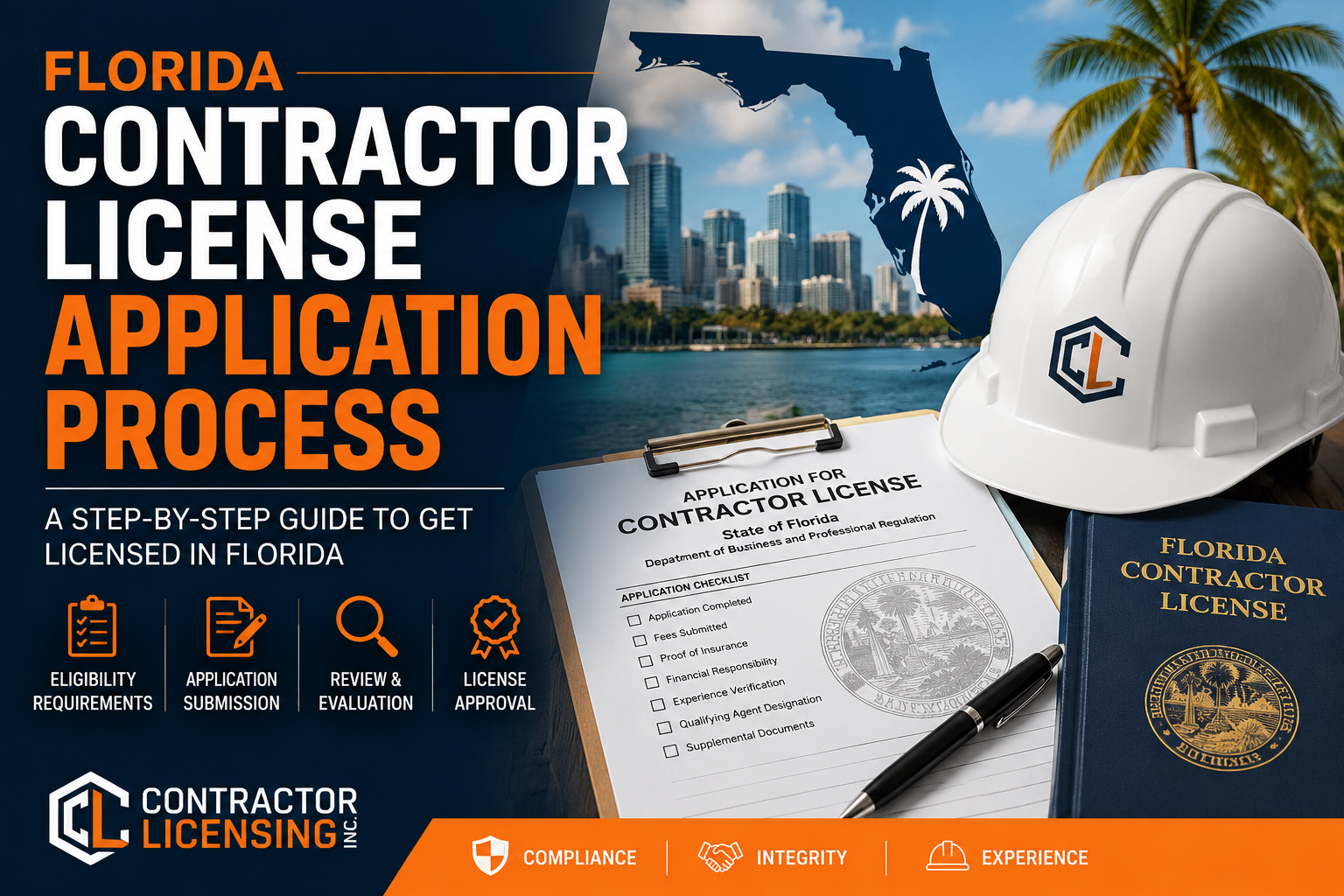
Step 4: Prepare Your Application Package
This is where most applicants run into problems. Florida’s CILB application is thorough, and every item must be complete and consistent with every other item. Inconsistencies — even minor ones like a name variation between your driver’s license and your LLC registration — generate deficiency letters that delay approval.
Your complete application package will include:
Core Application Materials
- Completed DBPR application form for your license classification
- Application fee (varies by license type; typically $200–$350)
- Notarized affidavit of integrity and good character
Experience Verification
- Experience verification forms completed by supervisors, employers, or clients who can attest to your qualifying construction experience
- The individuals signing must have direct knowledge of your work and be reachable for verification
- Letters must specify the type of work performed, your role, and the dates of employment or supervision
- Self-employed applicants must provide alternative documentation such as tax records, permits pulled, or client affidavits
Financial Documentation
- Credit report authorization (the board pulls this directly)
- Personal financial statement
- Documentation explaining any negative credit items, judgments, or liens
Insurance Documentation
- Certificate of insurance showing active general liability coverage
- Workers’ compensation certificate or valid exemption documentation declaration
- Your company must be named exactly as it will appear on the license
Exam Scores
- Official score reports from the testing provider for both required exams
- Scores must meet Florida’s current passing thresholds (typically 70% or higher)
Business Entity Documentation
- If applying under a business entity (LLC, corporation, or partnership), you must provide proof of entity formation and registration with the Florida Division of Corporations
- The entity must be in active status at the time of application
Fingerprint Submission Confirmation
- Receipt or confirmation of Livescan fingerprint submission through a DBPR-approved provider
Step 5: Submit and Track Your Application
Florida CILB applications are submitted through the DBPR’s online portal at myfloridalicense.com. Once submitted, your application enters an administrative review queue.
The initial review checks for completeness. If anything is missing, the board will issue a deficiency letter identifying what needs to be corrected or supplied. You typically have 30 to 60 days to respond to a deficiency before your application is administratively closed.
After deficiencies are resolved, your application advances to board review. The CILB meets periodically throughout the year to review and act on applications. Routine, complete applications are often processed administratively without needing a hearing. Applications involving credit issues, criminal history, or prior disciplinary matters may be set for a formal board hearing.
Timeline expectations:
- Complete applications with no deficiencies: approximately 60 to 120 days from submission to approval
- Applications requiring deficiency corrections: add 30 to 60 days for each correction cycle
- Applications requiring board hearing: timing depends on the board’s meeting schedule
Step 6: License Maintenance and Renewal
Florida contractor licenses must be renewed every two years. The renewal cycle is tied to your license classification and birth date. Requirements include:
- Continuing education (CE): Florida requires 14 hours of CE per renewal cycle for most certified contractor classifications, including specific hours in workplace safety, workers’ compensation, and business practices
- Insurance maintenance: Your coverage must remain active throughout the license term — lapses can trigger automatic suspension
- CILB compliance: Any open complaints, unpaid fines, or disciplinary matters must be resolved before renewal will process
Failing to renew on time puts your license in delinquent status, which carries a higher reinstatement fee. Licenses that lapse entirely require a more involved reinstatement process and may require board approval.
Legal and Compliance Considerations
Operating before your license is issued is illegal. A pending application does not authorize contracting work. Performing licensed contracting work before your Florida license is active — even one day before it issues — can result in unlicensed contracting violations, fines, and jeopardize your pending application.
Your license number must appear on all contracts, permits, and advertising. Florida Statute §489.119 requires that your license number be displayed on every contract, permit application, and advertising material. Failure to comply is a licensing violation.
The qualifying agent is personally accountable. The licensed individual who qualifies a business entity is personally responsible to the CILB for all work performed under that license. If the business commits violations, the qualifying agent’s license is at risk.
Insurance lapses can trigger automatic suspension. Florida requires contractors to maintain continuous insurance coverage. If your insurer reports a lapse to the DBPR, your license can be suspended automatically — without a hearing — until coverage is reinstated and reported.
Frequently Asked Questions
How long does it take to get a Florida contractor license? For a complete, well-prepared application with no deficiencies and no credit or background issues, expect approximately 60 to 120 days from submission to approval. Applications with deficiencies, credit issues, or criminal history take longer. Starting the process before you need the license — not after — is the single most effective timeline management strategy.
Can I apply for a Florida contractor license if I have bad credit? Yes, but it requires additional preparation. The CILB reviews your full credit history and exercises discretion on financially complex applications. Unresolved judgments, tax liens, or a recent bankruptcy don’t automatically disqualify you, but they require explanation, supporting documentation, and in some cases, a Financially Responsible Officer (FRO) arrangement. Addressing credit issues before applying — rather than trying to explain them mid-review — produces better outcomes.
Do I need to form a business entity before applying? Not necessarily. You can apply as an individual and qualify your entity after the license is issued. However, most working contractors apply as a business entity (LLC or corporation) from the start. If you apply under a business entity, that entity must be active and in good standing with the Florida Division of Corporations at the time of application.
What happens if I fail the exam? You can retake Florida contractor licensing exams, but there are waiting periods between attempts and additional fees for each sitting. Most applicants who prepare thoroughly with state-specific study materials pass on the first or second attempt. The Business and Law exam, in particular, rewards preparation — it tests Florida-specific statutes and CILB rules in significant detail.
Can an out-of-state contractor get a Florida license? Yes. Florida has limited reciprocity agreements with some states for specific license classifications. If your home state has a reciprocity arrangement with Florida, you may be able to waive one or both exam requirements. Even with reciprocity, you must still meet Florida’s experience, financial, insurance, and background requirements and submit a full DBPR application.
Get Your Florida Contractor License Done Right
The Florida contractor license application process is detailed, but it’s navigable — especially when you know what to expect and prepare accordingly. The most common reasons applications get delayed are preventable: missing documents, inconsistent entity names, inadequate experience letters, and insurance certificates that don’t match application details.
Contractor Licensing Inc. helps Florida contractors prepare and submit complete, board-ready applications the first time. From choosing the right license classification to organizing your experience documentation, managing your exam schedule, and handling deficiency responses when they arise — we manage the process so you can focus on your business.
Visit contractorlicensinginc.com or call our Florida office during business hours to get started. The sooner you begin, the sooner you’re licensed and working.
This article is for informational purposes only and does not constitute legal advice. Florida contractor licensing requirements are subject to change. Always verify current requirements with the Florida DBPR, the Construction Industry Licensing Board, or a qualified contractor licensing specialist before submitting your application.

Leave a Reply
Your email is safe with us.